
Nestled amidst the open space of the sky and the sea of Do Son, Bao Dai Villa stands majestically on the top of Vung Hill, carrying within it the historical stories of the last emperor of Vietnam's feudal dynasty. This is not just a unique architectural work but also a destination deeply imbued with the cultural and historical imprints of the port city of Hai Phong.
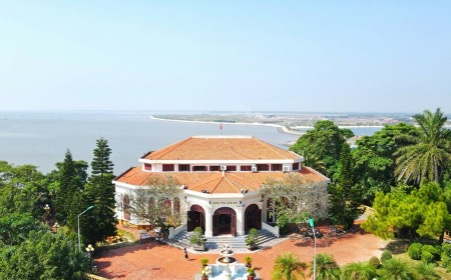
Báo Đại's Palace is situated on a high hill overlooking the sea (Photo source: http://Baovanhoa.vn)
The Journey from Villa Joséphine to Bao Dai Pavilion
The villa was built in 1928 by the Governor-General of Indochina, Pasquier, and was originally named Villa Joséphine. Intended primarily as a retreat for the colonial government, the villa occupies a prime location in Zone 2, Do Son, at an altitude of nearly 40 meters above sea level.
In 1932, upon returning from his studies in France, King Bao Dai visited the site and was profoundly impressed by its unique architecture and the beautiful surrounding natural landscape. Due to the King's fondness for the property, the Governor-General transferred the villa to him in 1949. Since then, the structure has been officially known as "Bao Dai Villa" or "Bao Dai Pavilion".
Throughout the period from 1933 to 1954, this was where the King, Empress Nam Phuong, and their family frequently visited to rest and work during their royal tours of the North. Although the original structure was destroyed during the war, in 1999, the local tourism management unit completely reconstructed it according to the original 1928 architectural prototype to serve visitors.
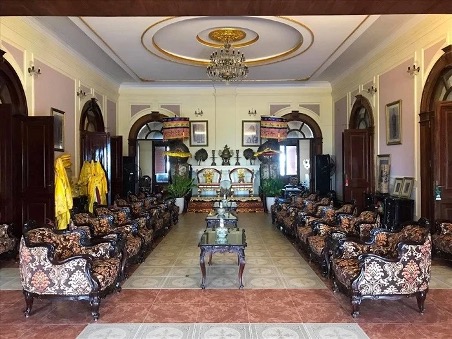
The ground-floor living room is furnished in a regal style reminiscent of ancient royal courts (Image source: Baolaodong)
Exquisite and Noble French Architecture
Situated on a campus of over 3,700 square meters, the octagonal villa, designed in a classical French architectural style, stands out amidst the lush green trees. The building has a usable area of approximately 1,000 square meters, structured with one basement and two upper floors.
- Basement: Designed as a space for the kitchen area, storage, technical rooms, and servant quarters. Notably, the kitchen area also features a secret escape route reserved for the Emperor in case of emergencies.
- 1st Floor: This is the primary living space for the royal family, featuring a luxurious living room, a dining room, and King Bao Dai's office. It also includes the private bedrooms of the King and Empress Nam Phuong, all furnished with noble interior pieces in the old royal style.
- 2nd Floor: Arranged as bedrooms for the princes (Bao Long, Bao Thang), the three princesses, and a room for Nguyen De, the Office Manager and a close confidant of the King during his reign.
The most prominent feature of the villa is that all rooms are designed to face the sea, maximizing natural light and sea breezes. From the second-floor balcony, visitors can enjoy a panoramic view of the Do Son peninsula, with the poetic Nghieng Wharf and Hon Dau Island in the distance.
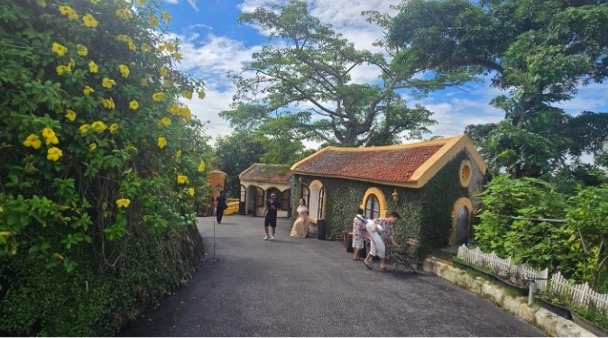
The road up to Bao Dai Palace (Photo from collected source)
Experiences Not to Be Missed
Visiting Bao Dai Villa, tourists do not just observe the architecture but also "relive" the royal atmosphere. Guides share interesting anecdotes about the life of this progressive-minded King, who was famous for his declaration: “I would rather be a citizen of an independent country than king of a slave nation”.
One activity that attracts many young people and families is the royal costume rental service. Visitors can transform into kings, queens, or royal family members to take check-in photos on the throne or in the nostalgic working corners of the villa.
Additionally, visitors have the opportunity to enjoy Hue royal cuisine right by the windy Do Son coast, with dishes prepared in a sophisticated and delicate manner. Furthermore, for those wanting to fully experience the quiet and noble space, there is a service to rent rooms for overnight stays in the former royal bedrooms.
Bao Dai Villa is more than just a relic; it is a place that preserves the soul of a bygone historical era. The combination of modern-classical French architecture along with authentic artifacts and images has created an irresistible charm, making this site a vital highlight on the Do Son tourism map.