
From June 24 to July 3, 2026, a high-level delegation from the Republic of Cuba conducted a comprehensive working visit to Vietnam to study and exchange experiences in building foreign investment policies and managing industrial ecosystems. Led by Ms. Yanet Vazquez Valdes, Vice Minister of Foreign Trade and Foreign Investment, the mission underscores the deepening "special friendship" between the two nations and provides a practical framework for Cuba to modernize its economic policies based on Vietnam's successful FDI attraction models.

A Strategic Mission Rooted in High-Level Agreements
The working trip was organized as a direct implementation of the Vietnam-Cuba Joint Statement issued during the State visit to Vietnam by the First Secretary of the Central Committee of the Communist Party of Cuba and President of the Republic of Cuba, Miguel Díaz-Canel Bermúdez, in late 2025. Following a proposal by the Cuban Embassy in Vietnam, the Ministry of Finance—specifically the Foreign Investment Agency (FIA)—coordinated a rigorous 10-day itinerary focusing on policy formulation, legal frameworks, and field surveys in dynamic economic hubs like Ninh Binh and Hai Phong.
The Cuban delegation comprised senior experts, including Mr. Marcel Casas Blanco (Director of Foreign Investment), Ms. Cinthya Rafael Toca Sanchez (Director of Legal Affairs at the Ministry of Foreign Trade and Foreign Investment), and Mr. Randy Arteaga Rodriguez (General Director of Legal Affairs at the Ministry of Finance and Prices).
Intensive Policy Exchange in the Capital
The mission began in Hanoi with high-level technical sessions at the Ministry of Finance. On June 25, the delegation worked with the Foreign Investment Agency to review the current status of investment cooperation between the two countries. Central to these discussions were Vietnam's "lessons learned" in creating a competitive legal environment for international capital.
Further sessions focused on specialized governance areas:
- Tax and Supervision: On June 29, the delegation met with the General Department of Taxation to study Vietnam’s tax policies for foreign investors and experiences in implementing Double Taxation Avoidance Agreements.
- Enterprise Reform: Discussions with the Department of Corporate Finance covered Vietnam's experience in restructuring State-Owned Enterprises (SOEs) and fostering cooperation between the state, the private sector, and foreign investors.
- Innovation Ecosystems: On June 30, the delegation visited the National Innovation Center (NIC) to study models for consulting, connecting, and attracting investment into innovative startups and high-tech sectors.
Field Studies in Hai Phong: A Blueprint for Industrial Success
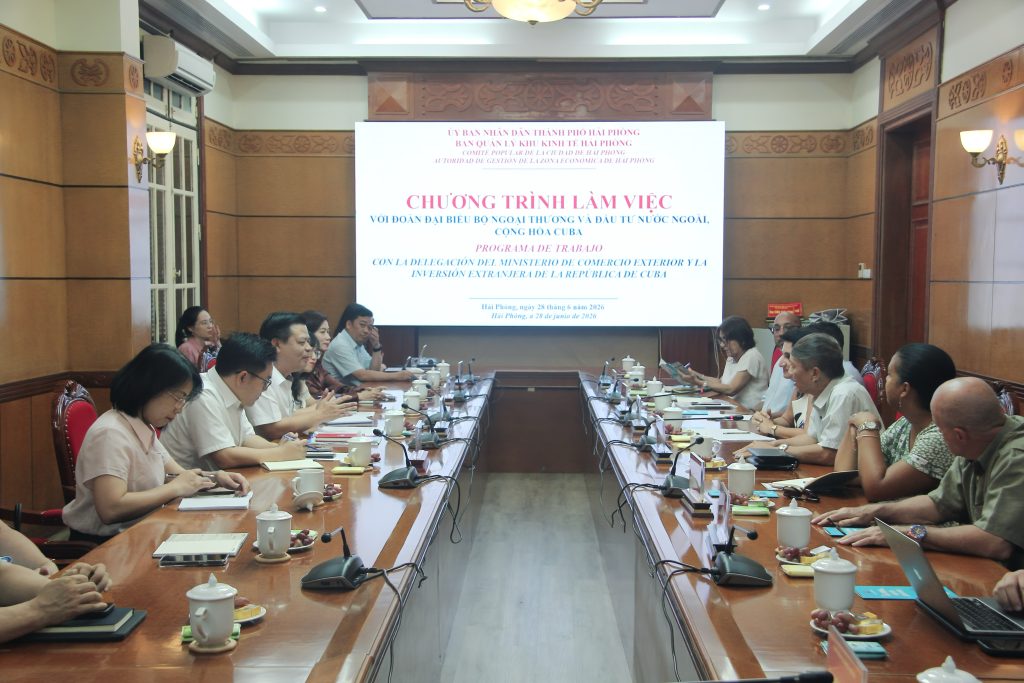
A significant portion of the trip was dedicated to Hai Phong City, recognized as a leading destination for FDI in Northern Vietnam. Between June 26 and June 28, the delegation engaged with the Hai Phong Economic Zone Authority (HEZA) to observe the practical application of investment policies.
During a formal working session on June 28, chaired by HEZA Head Mr. Phạm Văn Thép, the two sides discussed:
- Administrative Procedures: The specific functions and duties of local investment registration agencies and the "one-stop-shop" model for investment procedures.
- Investment Promotion: Effective strategies for regional promotion and supporting businesses post-investment.
- Modern Infrastructure: On June 27, the delegation conducted field surveys at world-class facilities, including the Hateco Group, the Hateco Hai Phong International Container Terminal (HHIT), and the Nam Dinh Vu Industrial Park & Non-Tariff Zone (developed by Sao Do Group).
These visits allowed the Cuban officials to witness how integrated logistics and "green" industrial park models can serve as engines for regional economic growth.
Meaning and Results: Policy Transfer and Brotherhood
The visit concluded with several key outcomes that hold long-term significance for both nations: (1) Practical Policy Insights: The Cuban delegation gained a comprehensive overview of the "Vietnamese model" for FDI, ranging from macro-level laws (such as the Law on Investment and the Law on Public-Private Partnership) to micro-level management of industrial zones; (2) Standardizing Legal Frameworks: The exchange on legal procedures and tax implementation provides Cuba with a proven template to refine its own regulatory environment, aimed at increasing its attractiveness to global investors; (30 Strengthening Bilateral Ties: Beyond technical expertise, the mission reaffirmed the unbreakable bond between Vietnam and Cuba. As Ms. Yanet Vazquez Valdes noted, Vietnam's success provides not just a roadmap but also inspiration for Cuba's path toward sustainable development.
By sharing its hard-won experiences in economic integration and industrial management, Vietnam continues to stand as a reliable partner and "elder brother" to Cuba. The results of this working trip are expected to catalyze new investment flows and policy reforms in Cuba, paving the way for a more prosperous and modernized Cuban economy in the years to come.