
Hai Phong has long been known as the largest seaport in the North of Vietnam. The favorable geographical location is one of reasons that make Hai Phong being one the biggest industrial, service, economic, and commercial centers of the country. Its expected rapid growth certainly goes with increasing of the driving force such as transport demand, industrial activities… which relate to the increase of Co2 emission.
Vietnam’s Government has committed to achieve the net zero carbon target by 2050. This is confirmed by the Prime Minister Pham Minh Chinh at the recent UN Climate Change Conference UK 2021 (COP26) As a local government in Vietnam, based on the national strategies and plans, Haiphong has formulated various action plans on green growth, reduction of CO2 emission to achieve low carbon city target including Action Plan to implement the National Green Growth Strategy, Action Plan to implement Paris Agreement, Haiphong Green Growth Action Plan. In the implementation of these plans, different task categories have been put in practice:
- Raise people’s awareness
- Identify green growth criteria, indicators, and integrate these criteria and indicators in the city’s middle- and long-term master plan of socio-economic development, specific sectoral plans.
- Study “green” models such as green port, green town, green industry…
- Renovate technology; encourage application of high-tech, green technology in production
- Promote using economically energy and resources, friendly environmental projects
- Apply new technology in production to reduce greenhouse gas emission
- Evaluate current production plans to make appropriate adjustment
- Enhance international cooperation.
International cooperation has been identified as an effective channel to support the achievement of the city’s target. Over the past time, Haiphong has built up partnership with numerous regional organizations, non-government organizations, local governments, government agencies from Japan, South Korea, the USA, OECD… to work on the subject. The cooperation has been realized in practice with various forms of activities including: policy development, research and study, pilot production, high tech transfer, human resource training, sharing lessons-learnt and experiences, dialogues etc.
The cooperation relationship between Hai Phong and Kitakyushu was first established in 2009 and has officially become sister cities since 2014. Since then, the two cities have actively exchanged and coordinated in different fields including economic development, culture, healthcare, education and environment and have experienced different valuable joint-projects which create positive contribution to both long term direction as well as specific technical solutions for Haiphong on the way towards green growth and low carbon city.
Within the framework of “sister-cities” relationship, Kitakyushu supported Haiphong to developed the Green Growth Promotion Plan in 2015 with 15 pilot specific projects in the areas of waste treatment (Waste Heat Recovery Power Generation & Utilization of Industrial Waste, Recycling of E-Waste), green transportation (introduction of low-emission buses, energy saving and introduction of renewable energy &EV buses in Cat Ba Island), energy saving (Energy savings and introduction decentralized energy systems in factories & buildings), green production (Promotion of green agriculture, Installation of high-efficiency furnaces in foundries), … . The implementation of these project has proved the evidences of contributing to the carbon reduction in Haiphong. For example, the waste treatment project which is carried out by Haiphong Urban Environment Company (URENCO) apply the Takakura Composting Method. Composting can reduce CO2 by lowering methane gas emission from reducing organic waste to be dumped into the landfill and also from the transportation of waste (fuel consumption decrease). Replacing chemical fertiliser with organic fertiliser also reduces CO2 emissions.
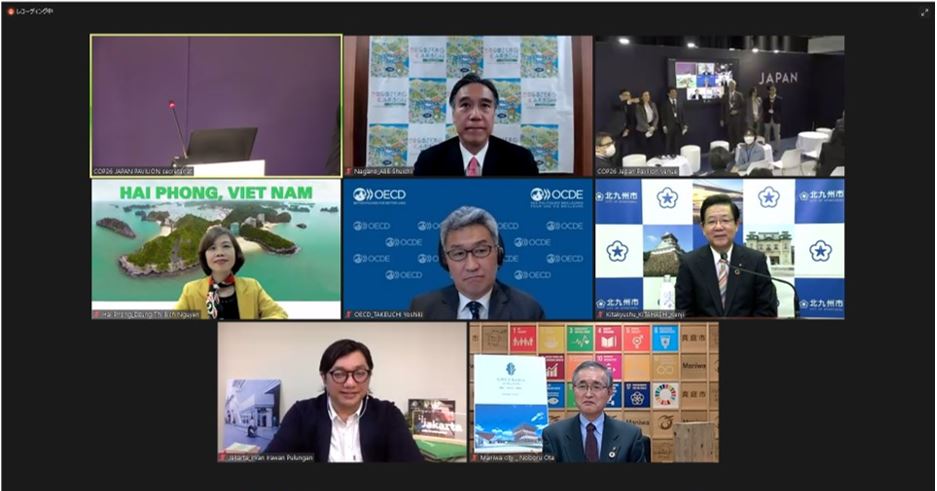

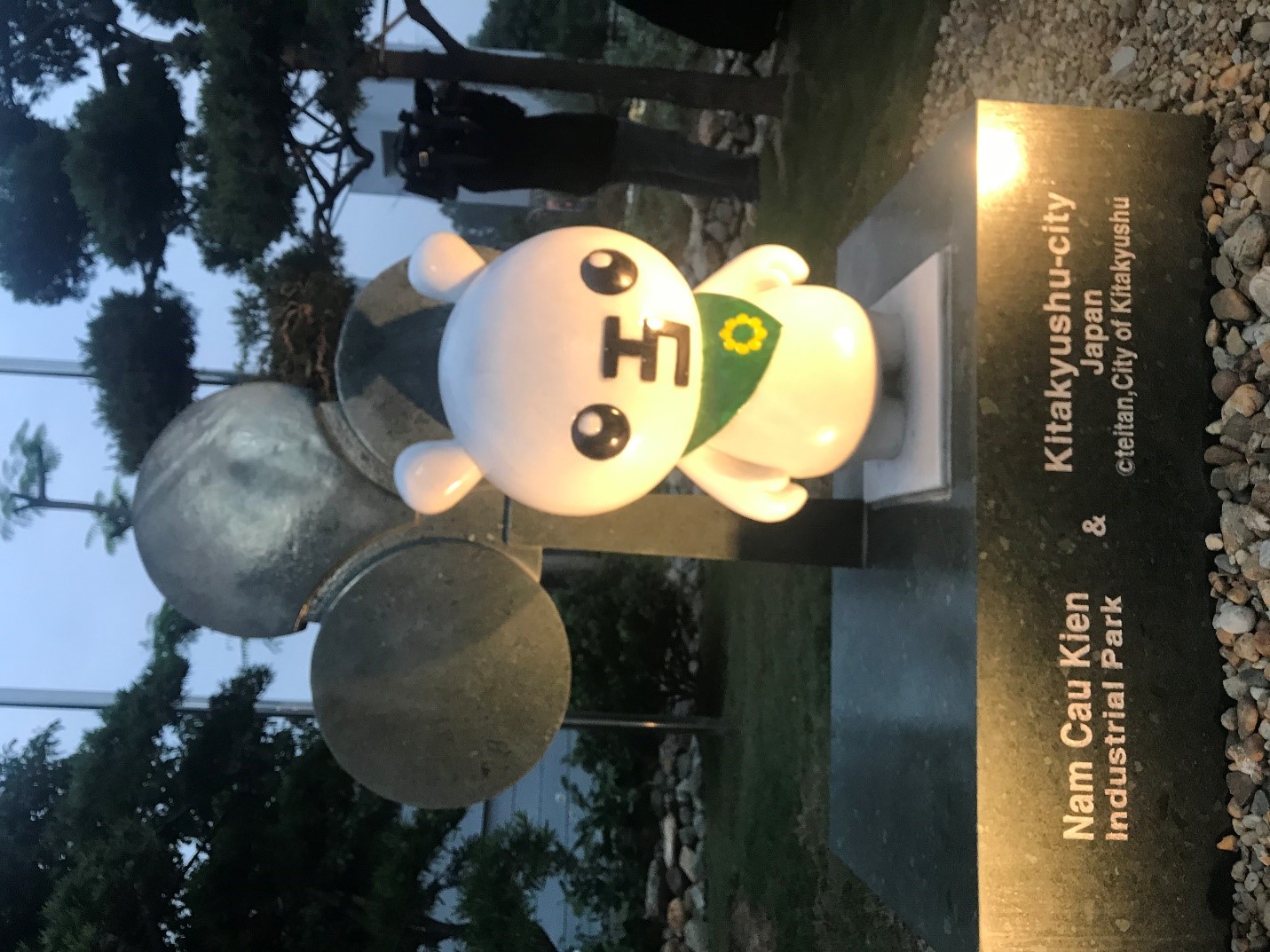
Currently, Haiphong and Kitakyushu are working on the development of Eco-industrial park model in Haiphong with the participation of two industrial parks (Nam Cau Kien and Deep C). The objective of the project is to achieve zero-emission in industrial estates in Haiphong through:
- Transfer experiences and know-hows of Kitakyushu on 100% renewable energy installation in all public buildings and Eco-town management; and
- Conduct feasibility studies of low carbon technologies in the eco-industrial parks including smart energy system, renewable energy; energy recovery from waste water, and energy savings.
For the future, Haiphong will focus on effectively implementing the solutions, activities set out in the approved action plans. International cooperation remains playing an important role for experience sharing, lessons-learnt, investment resource, as well as regional and global joint effort projects. In this process, the city will definitely continue to work hand in hand with Kitakyushu city to realize a zero carbon city.