
Currently, the world has a definition of international city. In major understanding, international city carries on international features regarding appearance, scale and operation. Image of an international city is grounded by many factors, in which there are:
i)International city’s role and influence to other cities in the world, in economic, human source, and political terms.
ii)International city’s competitiveness on sources attraction from companies, groups, labors (including blue- and white collars) for manufacturing, business, market establishment and expansion, settlement and occupations.
iii)International city’s inner strengths are not only in economic and financial terms but also in cultural, identical, and historic terms.
iv)International city’s connectivity to global network in all fields and gets international community’s recognition.
v)International city’s unstoppable movement and change in eco-social development.
According to the Global City Index (GCI), factors such as human source, economic growth, high competition, stability and security are those that impact one city’s appearance on global scale. Also, according to the GCI, human resource (including mechanical immigration) plays an important role in building up international city’s appearance[1].
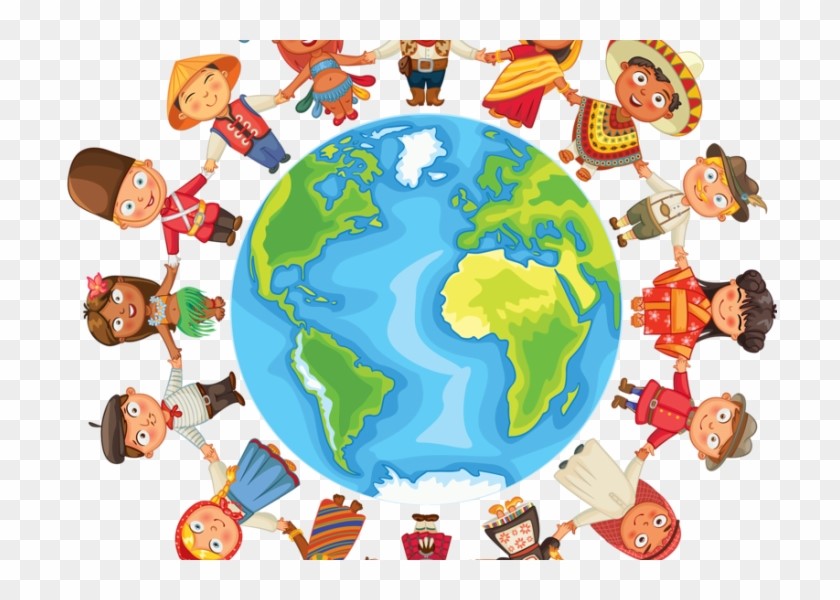
Cultural diversity is not only a feature but also a trend in developing international cities. Photo source: https://www.clipartmax.com/middle/m2i8d3b1m2m2H7G6_crèche-farandole-cultural-diversity-around-the-world/
In the context of globalization, international cities have become crucial cities in the global network of economy, finance, telecommunication, etc. In globalized economy, international cities have close ties with transnational groups, finance service providers, banks, and they have been places of transnational groups’ headquarters. According to UNCTAD, a majority of transnational groups’ headquarters are located in the USA, EU, or Japan. Indeed, according to the UNCTAD, there are a number of transnational companies located in the USA, France, Germany, the UK, Japan, Switzerland, Finland, the Netherlands, etc. Following UNCTAD’s 2021 global investment report, many transnational companies valued USD millions working in terms of telecommunication, petroleum, pharmaceuticals, foods and beverages, electricity, etc. have got headquartered in the USA, the UK, Singapore, Taiwan (China), etc.[2]. During recent years, the number of transnational groups has been growing. Companies such as Singtel, LG Electronics or Cemex have expanded business in developing countries and many other places in the world. In fact, the appearance of transnational groups by their headquarters/representative offices establishment has contributed to make image of international cities.
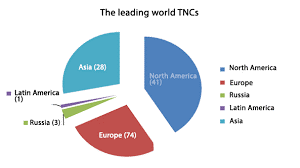
By-region distribution of top 100 transnational groups in the world.
Source: Atlantis Press (ICSDCBR 2019)[3]
International cities have high economic growth that significantly contributes to economies nationally, regionally, and globally. In other words, international cities have been recognized as wealthy cities in the world. By the formula GDP = personal expenditure + business investment + Government expenditure + Government investment + (Export – Import)[4], GDP expresses a city’s wealth. For international cities, the higher is the city’s GDP, the wealthier is the international city. According to 2018 World Population Review, Tokyo’s GDP (Japan) reached over $1.5 thousands billion, following were New York (the USA) with over $1.2 thousands billion, Los Angeles (the USA) with over $780 billion; Seoul (South Korea), London (the UK), Paris (France), Osaka (Japan), Chicago (the USA), Moscow (Russia), Shanghai (China)[5].
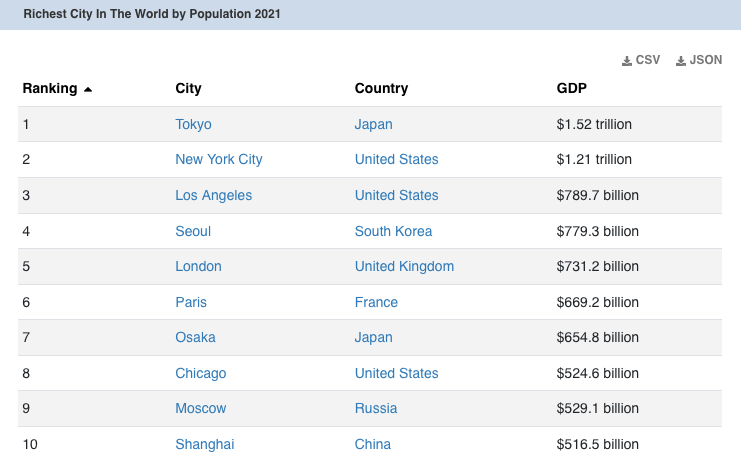
List of the wealthiest cities in the world in 2021. Source: https://worldpopulationreview.com/world-city-rankings/richest-city-in-the-world
One interesting point is that international cities have been not only wealthy in economic and financial terms but also in cultural diversity and long historical development. Plus, those cities have had crowded and diverse populations. According to the World Population Review’s data, number of residents has been increasing in New York during current decades; in 2020, New York residents went up to 08 million, with a density of more than 27.000 inhabitants/squared mile, white Americans accounted for over 42%, African Americans were more than 24%, Asian Americans were over 14%[6]. In Europe, Paris (France) has got a high volume of immigration; Parisians have been also diverse with different races. In Tokyo (Japan), cultural diversity has been one of outstanding points of this city, with contribution of foreigner communities (Chinese, Korean, Pilipino, Vietnamese, Brazilian, etc.) to the city’s eco-social life.
Another point is that those cities have facilitated developed port systems. Indeed, London Port (the UK) has been one of the biggest ports in the South East of England, and the third biggest port of the UK. London Port handles on average over 53 million ton of goods transmitted by over 12,000 commercial vessels to the port annually. Operation of London Port has significantly contributed to the UK’s incomes[7]; full time jobs creation for over 45,000 people, contribution to the UK more than 4 billion sterling pounds annually. In Asia, Tokyo Port (Japan) has been one of the biggest ports of Japan, and being located in the basin area of the Pacific Ocean; Singapore port has been one of the biggest in the world, and one of the busiest container transit centers. In fact, Singapore port has connected with more than 600 ports in over 120 countries. On average, Singapore port has attracted about 130,000 cargo ships[8].
Currently, emerging economies in Asia, the Middle East, and China have made contribution to grow the number of international cities worldwide. According to 2014 GCI, Asia-Pacific region owns most of international cities in the world. Indeed, Tokyo (Japan), Hong Kong, Beijing, Shanghai (China), Singapore (Singapore), Seoul (South Korea), Sydney (Australia) have lifted up Asia-Pacific to a higher rank compared to North America, and equivalent place to Europe regarding the number of international cities.

Cultural diversity contributes to international cities’ vitality.
Photo source: https://confetti.ac.uk/world-day-for-cultural-diversity/
During the COVID-19 pandemic, such factors as number of medical universities, startups, make contribution to international cities’ features. That fact is explained by two points: i) startups carry out innovation and transformation in research, manufacturing, business, vitalizing and upgrading international cities; ii)number of medical universities contribute directly and indirectly to endurance and elasticity of international cities, competitiveness of international cities in terms of sources. In fact, cities such as London (the UK), New York (the USA), Tokyo (Japan), Singapore (Singapore), etc. have implemented financial packages for startup activities, encouraging startups, business incubation, investing and supporting R&D programs in application tech field, health care, business, etc. to stimulate startup spirit, innovation in residential communities, attract talents from all over the world to move in, settle, work, and do business in international cities.
In the context of globalization and integration, boosting and developing big cities to become international cities has been a demand of many developing urban cities. In Vietnam, some big cities under the central Government Administration, have promoted researches and proposals of implementing measures to become a city of regional and international stature in upcoming decades. For Hai Phong city, Resolutions of the City Party Congress 14, 15, 16 identified targets: basically, complete industrialization and modernization, becoming an industrial city towards modernity, a key to develop marine economy, an international tourism center; creating a solid foundation to become a modern, civilized and sustainable industrial city of Southeast Asia by 2030. Three main economic pillars of the city were identified: high tech industries, port a – logistics, tourism – trade (mentioned at Resolution no. 45-NQ/TW of the Politburo). All potentials and resources attraction have aroused for breakthrough development of urban and transport infrastructures. Focus on speeding up key transport infrastructure projects with a target that is, by 2025 Hai Phong would own a synchronous, modern and continuous transport infrastructure system serving realization of the goal of becoming an international trade center. Successfully implement the above tasks would contribute to create a new stature and appearance of the city, attracting resources, multinational corporations and international organizations to the city./.
[1]https://thediplomat.com/2014/04/asia-pacific-has-seven-of-the-worlds-top-20-global-cities/
[2]https://unctad.org/system/files/official-document/gdscsir20041c3_en.pdf
[3]International Conference on Sustainable Development of Cross-Border Regions: Economic, Social and Security Challenges (ICSDCBR 2019). Advances in Social Science, Education and Humanities Research, volume 364
[4]https://www.worldometers.info/gdp/what-is-gdp/
[5]https://worldpopulationreview.com/world-city-rankings/richest-city-in-the-world
[6]https://worldpopulationreview.com/us-cities/new-york-city-ny-population
[7]http://www.pla.co.uk/Port-Trade/About-the-Port-of-London
[8]https://www.ship-technology.com/projects/portofsingapore/