
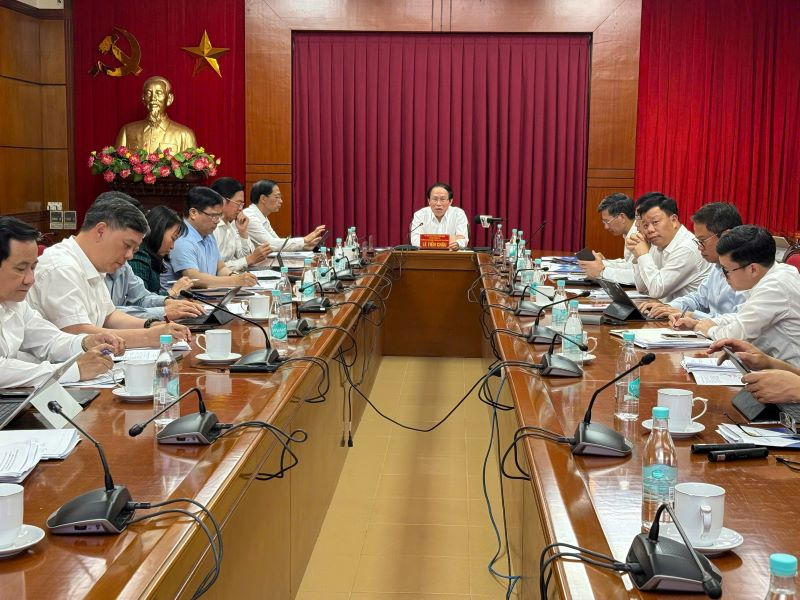
Comrade Le Tien Chau, Secretary of the City Party Committee, Head of the Steering Committee for the Development of the Southern Hai Phong Economic Zone chaired the conference.
In the afternoon of April 16, Comrade Lê Tiến Châu, Member of the Party Central Committee, Secretary of the City Party Committee, Head of the National Assembly Delegation of Hải Phòng, and Head of the Steering Committee for the development of the Southern Economic Zone of Hải Phòng, chaired the first meeting of the Steering Committee. Present were Comrade Đỗ Mạnh Hiến, Permanent Deputy Secretary of the City Party Committee and Deputy Head of the Steering Committee; members of the Standing Committee of the City Party Committee; and leaders of various departments and locality representatives who are members of the Steering Committee.
Comrade Lê Trung Kiên, Member of the Standing Committee of the City Party Committee and Head of the Hải Phòng Economic Zone Management Board—the permanent office of the Steering Committee—reported on the progress achieved. Accordingly, the Economic Zone covers approximately 20,000 hectares across five urban districts and rural districts, encompassing 21 wards and communes. Among this, there are about 4,000 hectares of industrial land; 2,000 hectares of urban land; 3,200 hectares of logistics land; 2,000 hectares for the port; 1,500 hectares for the airport, as well as green and transport land. The Management Board is coordinating with relevant departments to complete the master planning of the Southern Economic Zone, aiming to submit it to the Government for approval in 2025.
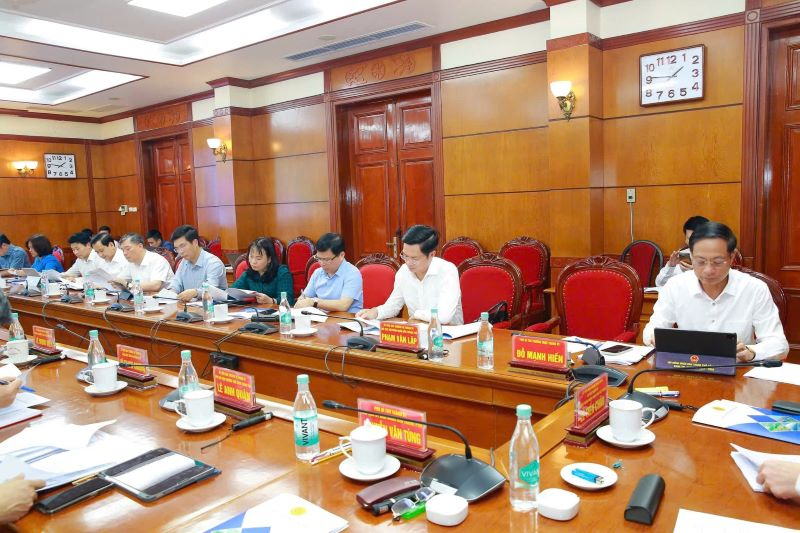
Conference overview
Additionally, the Tien Lang Airport project and six industrial parks (including Trấn Dương; Tiên Lãng 1 and 2; Tân Trào; Ngũ Phúc; Trấn Dương-Hòa Bình) have been studied by investors; two industrial clusters (Tân Trào and An Thọ) have been established; and four additional clusters are currently in the planning stage. The locations of the 2,000 hectares of urban land have also been clearly defined across localities.
The planning also includes a commercial-service logistics area and a free trade area. Notably, investors have begun feasibility studies to construct a complex encompassing a port, a gas fired power plant, a shipbuilding factory, industrial parks, and a logistics center, with total investment totaling several tens of billions of USD.
At the meeting, Steering Committee members outlined the works carried out in planning, investment procedures, investor selection, and ensured security, fire prevention, and environmental protection. They also proposed recommendations to accelerate the implementation of the Economic Zone.
In his conclusion, Secretary of the City Party Committee Lê Tiến Châu emphasized that the Southern Economic Zone represents a broad development space for Hải Phòng and called for strong focus on implementation.
The Secretary spelled out certain development orientations for the Southern Economic Zone: minimizing the development of industrial clusters; determining appropriate sizes for industrial parks; focusing on building smart urban areas and leveraging the advantages of the Lào Cai–Hà Nội–Hải Phòng railway line; and locating industrial parks and free trade areas fully within a single administrative unit.
Regarding the master plan, he directed the City Party Executive Committee to instruct the Management Board to coordinate with departments and localities to urgently complete the plan, submit it to the City Party Standing Committee, propose to the City People’s Council, submit to the Ministry of Construction in August, and to the Prime Minister in September 2025. Simultaneously, carry out parallel procedures to accelerate the Economic Zone’s implementation and execute the comprehensive plan for 2025–2030 as identified.
The Secretary also directed that the goal and development orientation for the Southern Economic Zone be digital, smart, and ecological, creating differentiation and enhancing competitiveness.
Concerning the complex of port, gas fired power plant, shipyard, industrial parks, and logistics center, he instructed the Management Board and departments to work concretely with investors, clarifying the scope, scale, technology, each sub project, and investment phases, and report to the Party Committee Standing Committee.
The Secretary instructed the City People’s Committee to clearly assess the effectiveness, budgetary contribution, and ensure national security and defense of the project by April 2025 as a basis for consideration and decision making. At the same time, efforts should be made to kick off certain projects within the Economic Zone in 2025. He assigned the Steering Committee's permanent office and members to contribute to completing the Working Regulations of the Committee for signing and issuance by the Head of the Steering Committee.