
* Hai Phong is allowed to borrow from the Central Government’s foreign loan, within a total outstanding balance not exceeding 60% of the city’s budget revenue.
The city’s budget enjoys 100% of additional revenue from revenue generated from adjustment of the fees and fees policy.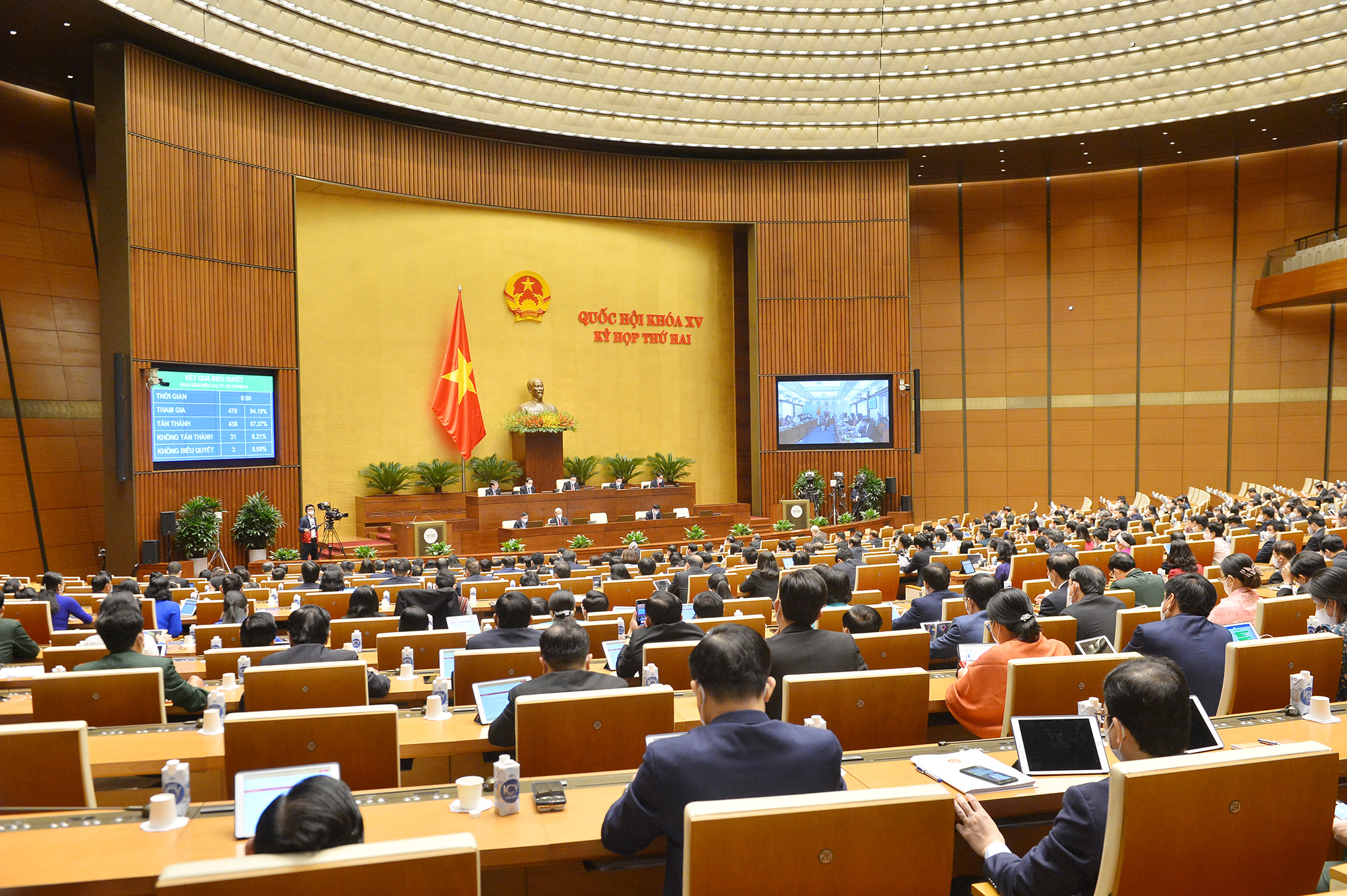
Overview of the meeting (Photo: quochoi.vn)
On November 13 morning, under management of the National Assembly’s Vice Chairman, Mr. Nguyen Duc Hai, delegates voted to approve a Resolution on some specific mechanisms and policies for cities and provinces’ development. Among them, the specific mechanism for Hai Phong was approved by 442/477 delegates participating in the meeting, accounting for 88.58% that was the highest rate.
The specific mechanism for Hai Phong to spectrum the city’s strengths, particularly its marine economy
Report, receive, explain to the National Assembly’s delegates on the National Assembly’s drafted Resolution on implementation pilot of specific mechanisms and policies for development of Hai Phong City, Thanh Hoa, Nghe An, Thua Thien – Hue provinces, the National Assembly’s Finance and Budget Committee’s Chairman, Mr. Nguyen Phu Cuong informed, promulgation of those specific mechanisms and policies were thoroughly grasped by the Politburo's resolutions. The selected cities and provinces are localities owning specificities on geography, population, history, culture and potentials for economic development. Hai Phong is the largest port city in the North of Vietnam, one of economic locomotives, but has the same mechanisms as other provinces have been doing, which would make it difficult to exploration the strength of the city, particularly the marine economy.
There were inquiries to the Central Government to make a comprehensive summary of the localities’ current implementation results, before the Resolution promulgation. It was requests for specific Resolution for each region, preference for mountainous areas and ethnic minorities; and for evaluation on policies’ impacts upon budget revenues. There was a comment on lowering the ceiling of outstanding loans to avoid influence on other localities.
The National Assembly’s Standing Committee acknowledged that regulation of the ceiling of outstanding loans for localities aimed to create room for localities to actively mobilize resources, then, on the basis of summarization they would determine appropriate levels. According to State Budget Law, on the other hand, based on demands for capital mobilization, estimated collection capacity, capital absorption capacity and debt repayment capacity of each locality, annually the National Assembly decides localities borrows, in order to appropriate and fair distribution. The aforementioned mechanism application does not impact room to get loans from other localities. Therefore, the National Assembly’s Standing Committee asked the National Assembly to keep the regulation as it was in the drafted Resolution.
Hai Phong gets loans through local government bonds issuance
According to the Resolution on implementation pilot of some specific mechanisms and policies for Hai Phong City’s development approved by the National Assembly, Hai Phong would loan through issuance of local government bonds, get borrows from domestic finance organizations, other domestic organizations, and foreign borrows loans taken by the Government then on-lending to the city with a total loan balance not exceeding 60% of the city's budget revenue as decentralized. The city’s total loan and budget deficit would be annually decided by the National Assembly, according to the State Budget Law.
Particularly, the city’s budget would receive 100% of additional amount from revenues born by adjustment of fees and charges, as being regulated at Clause a of that Article, for eco-social facilities investment and other expenditure tasks under the city budget’s expenditure tasks, and that additional amount would not be used to determine division percentages between the city budget and central budget.
Spending to increase the average income of cadres, civil servants and public employees
Regarding income of cadres, civil servants, and public employees under the city’s management, the Resolution decides that the city would operate the source-generating for salary reform, according to the regulation. After the city budget secures enough sources to implement wage reform and social welfare policies for the whole period of budget stability according to competent authorities’ regulations, the City People's Council can decide to use the city budget’s residual salary reform source and allow subordinate budgets to use the residual salary reform source to spend additional average income for cadres, civil servants and public employees working in government agencies, the Party and mass organizations managed by the city, according to working efficiency, the level shall not exceed 0.8 time the salary by rank, grade or working position, title, leadership position. The level of income level for experts, scientists and talents will be decided by the City People’s Council./.