
On the morning of August 1, 2026, at the International Convention Center (Hanoi), the Ministry of Foreign Affairs solemnly opened the 33rd Diplomatic Conference with the theme “Promoting the pioneering role, implementing the key and regular tasks of Vietnam’s Foreign Affairs in the new era”. The conference takes place as the country stands before historic opportunities following the success of the 14th Party Congress, affirming a new posture for Vietnamese diplomacy on the journey to conquer 100-year development goals.
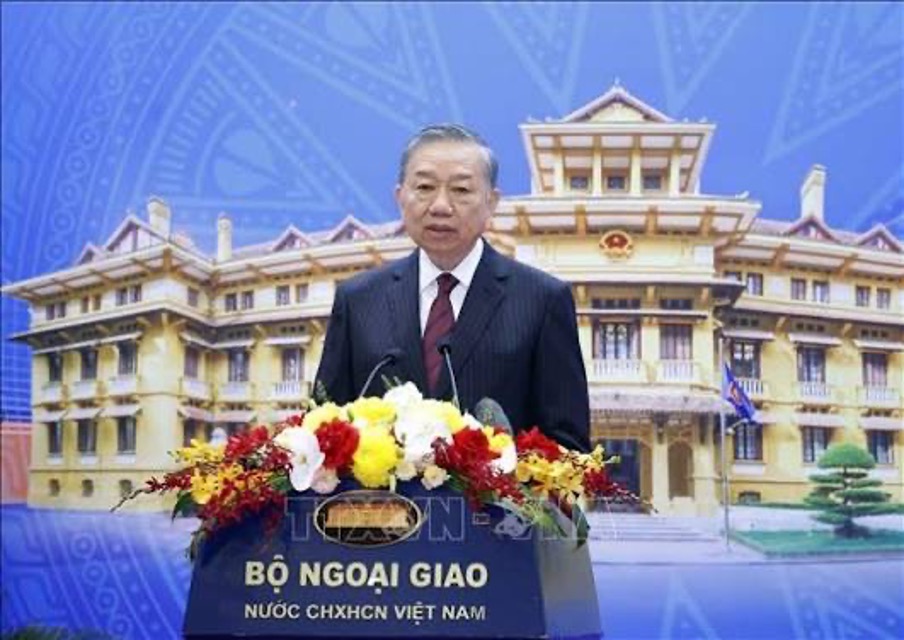
General Secretary and President To Lam delivered a speech at the Conference (Source: TTXVN)
The Stature and Special Significance of a Historic Conference
The 33rd Diplomatic Conference holds special significance with three turning-point "firsts". This is the first diplomatic conference held during the 14th Congress term as the country officially enters a new era of development. For the first time, Party documents designate foreign affairs and international integration as a key and regular task with new contents regarding strategic autonomy and self-reliance. Notably, it is also the first conference held after the foreign affairs apparatus was rearranged and perfected into a unified bloc under the comprehensive leadership of the Party.
The conference was honored to welcome General Secretary and President To Lam, who attended and provided guidance. The presence of the Head of Party and State, along with members of the Politburo, the Secretariat, and leaders from various departments, ministries, sectors, and localities—at both the direct bridge and 103 overseas representative offices—demonstrates deep concern and high expectations for the diplomatic sector in the new era.
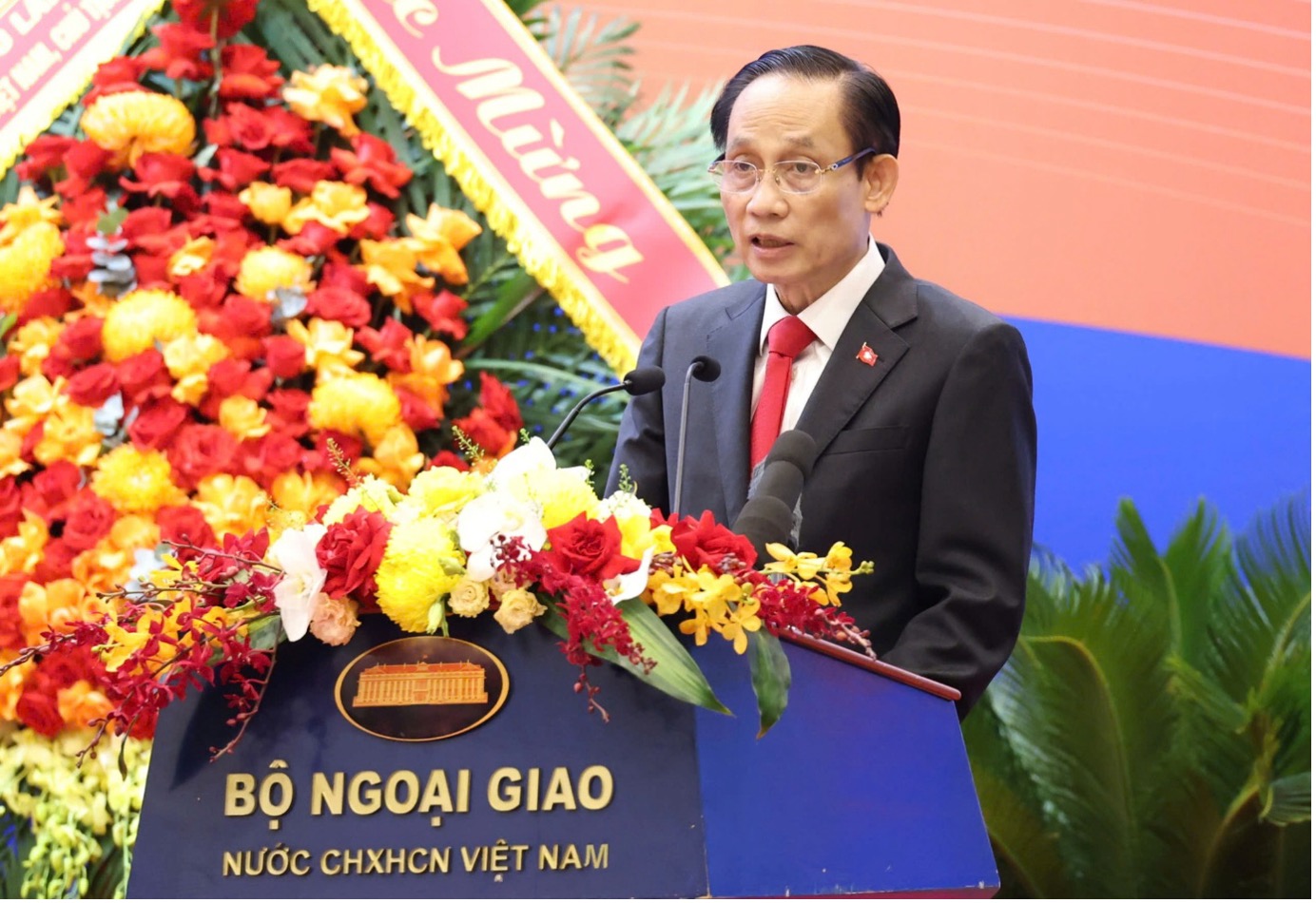
Minister of Foreign Affairs Le Hoai Trung delivered the opening remarks at the Conference (Source: https://mofa.gov.vn)
Clarifying the "Pioneering" Role and a Unified Foreign Affairs Apparatus
At the conference, Minister of Foreign Affairs Le Hoai Trung clarified the sector's new role within the national governance scheme. A major breakthrough was the merger of the Ministry of Foreign Affairs with the Central Foreign Affairs Commission, alongside assuming certain functions of the National Assembly's Foreign Affairs Committee. This streamlined the apparatus, reducing focal points by 42.8% to create a concentrated, elite, and professional foreign affairs force.
The role of the Ministry of Foreign Affairs is no longer merely conducting external relations but has become a key component of national aggregate strength. Specifically, the establishment of the Central Steering Committee for Foreign Affairs and International Integration, led by the General Secretary and President, elevates foreign affairs work to the highest level, ensuring unity in guidance and implementation. The diplomatic sector is tasked to "anticipate and lead", unlocking new resources and participating in shaping international cooperation frameworks instead of merely receiving them passively.
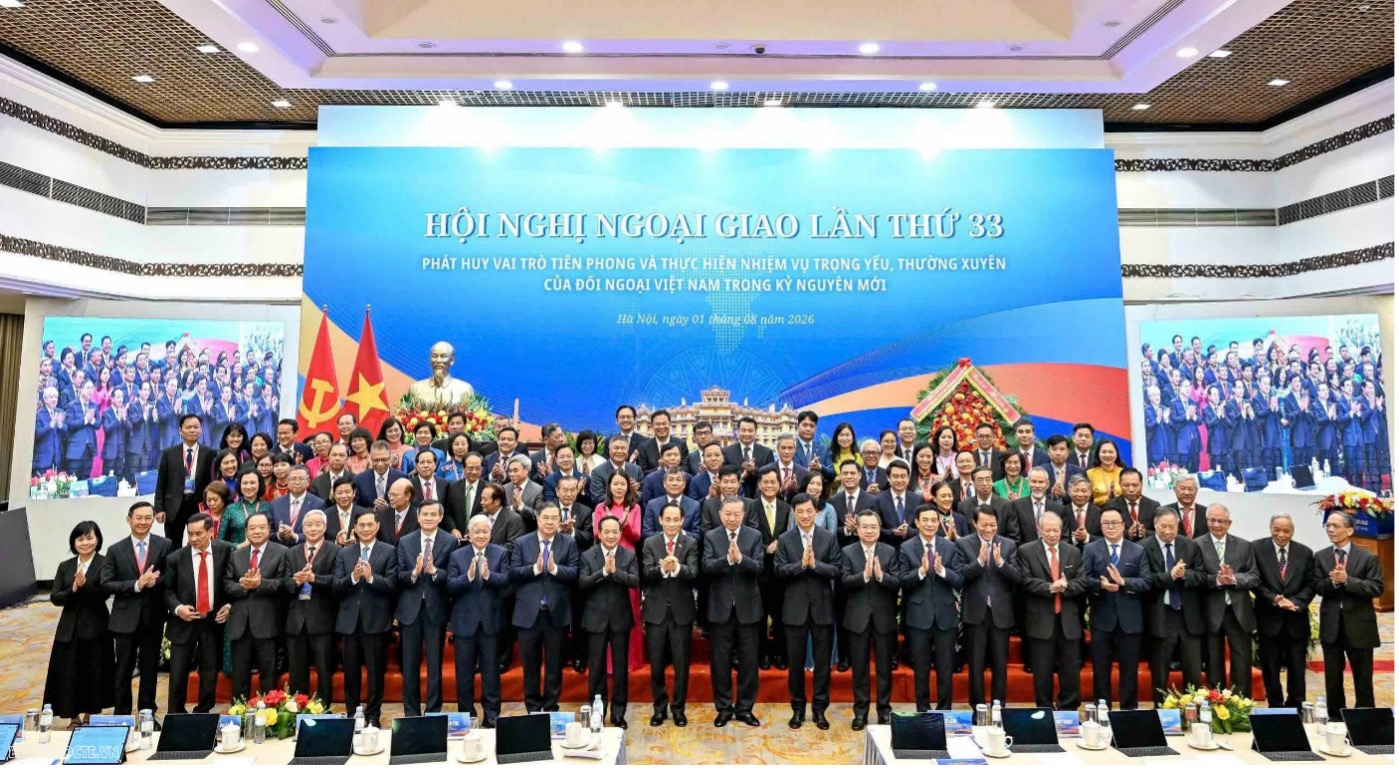
Delegates attending the conference pose for a commemorative photo (Source: https://mofa.gov.vn)
Brilliant Achievements and the Foundation of 40 Years of Renovation
Reports at the conference photted a comprehensive success story of foreign affairs in recent times. Building on the achievements of 45 years of economic assessment and 40 years of Renovation, the country's position and stature have reached new heights.
- In politics and high-level diplomacy: Vietnam has established and upgraded relations with 9 Comprehensive Strategic Partners, 11 Strategic Partners, and 5 Comprehensive Partners. High-level diplomacy, especially summit diplomacy, has played a leading role in increasing political trust and opening new cooperation spaces with neighboring countries, major powers, and traditional friends.
- In economy and integration: Vietnam has signed 17 Free Trade Agreements (FTAs) with over 60 countries and territories. Export-import turnover in 2025 is estimated at approximately 930 billion USD, placing Vietnam among the top 20 global economies in trade scale. Registered FDI reached over 38 billion USD, with realized capital exceeding 20 billion USD—record figures proving Vietnam to be a safe and attractive destination.
- In multilateralism and international prestige: Vietnam made a significant mark by successfully organizing the ASEAN Future Forum and holding important positions at the UN, UNESCO, and the Human Rights Council for the 2026-2028 term with the highest number of votes. Vietnam is no longer just a recipient of support but has become a country with active and responsible contributions to global issues.
Facing "Bottlenecks" and Challenges
Despite the results, the conference devoted adequate time to identify limitations with the spirit of "doing it right, doing it thoroughly". General Secretary and President To Lam and Minister Le Hoai Trung frankly pointed out current shortcomings:
- Research and forecasting: Occasionally fails to keep pace with rapid global changes; some reports are overly descriptive without clearly identifying impacts or proposing specific solutions.
- Transformation of commitments: Converting high-level agreements into actual projects and programs remains slow; the effectiveness of exploiting relations is uneven across regions.
- Cadre capacity: The skills of a portion of staff regarding technology, the digital economy, international law, and data have not met the requirements of the new phase.
- Coordination: Inter-agency coordination mechanisms between central and local levels are sometimes overlapping without clear final responsibility, leading to "bottlenecks" in execution.
Six Key Tasks and Directions for Implementation in the New Era
To elevate Vietnam's foreign affairs, the General Secretary and President outlined six key task groups through 2030:
- Innovate thinking in strategic research and forecasting: Moving strongly from forecasting events to forecasting trends; from reactive handling to proactively creating cooperation frameworks. Research must focus on issues directly impacting Vietnam's security and development, such as semiconductors, artificial intelligence (AI), the digital economy, and green transition.
- Deepen relationships: Upgrading relations is not the end of work after a visit but the beginning of a substantive implementation phase with measurable products. Sincerity and trust must be the foundation to handle differences, ensuring national interests come first.
- Bring foreign affairs for development into depth: Economic diplomacy must follow the new growth model, prioritizing resources for science, technology, and innovation. Representative offices must understand domestic needs to match with suitable partners. Notably, the role of the overseas Vietnamese community must be promoted not just as an object of care but as a vital resource participating deeply in national development.
- Elevate multilateral diplomacy: Continue to promote roles in ASEAN and international forums, proactively proposing initiatives to solve global problems.
- Align international integration with institutional improvement: Strictly implement international commitments to improve competitiveness while maintaining economic autonomy. Remove "bottlenecks" in overlapping regulations to receive external opportunities more effectively.
- Build a "Red and Expert" cadre: Cultivate a generation of diplomats based on the "6 dares" spirit: dare to think, dare to speak, dare to do, dare to take responsibility, dare to innovate, and dare to face difficulties. There must be mechanisms to discover and utilize talent while tightening discipline throughout the sector.
Hai Phong Proactively Implements the Spirit of the Conference
At the Hai Phong City Party Committee bridge, local leaders seriously grasped the conference's contents. As a leading locality in investment attraction and integration, Hai Phong determined to concretize the directives into action plans. Specifically, the city will focus on coordinating with overseas representative offices to promote economic diplomacy, attracting high-tech, semiconductor, and green energy projects, contributing to realizing a new growth space for the Port City.
The 33rd Diplomatic Conference concluded with high unity in perception and action. With the bravery of "dĩ bất biến, ứng vạn biến" (using the unchangeable to cope with all changes) and a strong spirit of innovation, the sector commits to successfully performing its pioneering role in building and protecting the Fatherland as Vietnam enters its new era of development.