
According to statistics of the World Bank (WB), there has been currently more than 50% of global population living at urban areas; and predictably by 2045, urban residents would increase up to about 6 billion[1]. Urban development has been a trend occurring in many countries for recent decades. The belowing table shows that, in the common trend across the world, Asian region has had the most number of increasing population and it forecasted to continuously grow ongoing time.
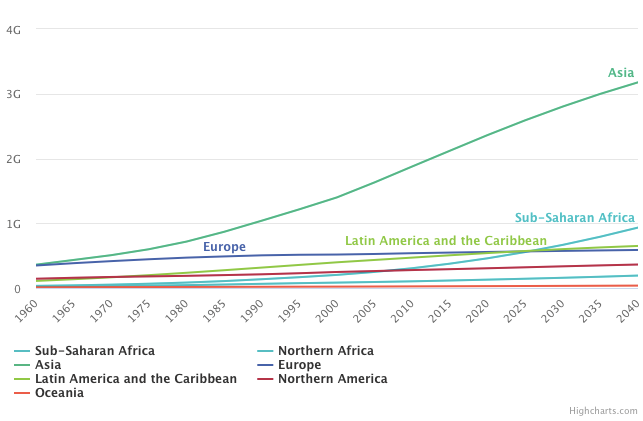
Urban population growth at Asia, Europe, Latin America and Caribbean, Northern America, Northern Africa, Oceania, Sub-Sahara Africa during the years of 1960-2020 and forecasting for 2020-2040. Source: https://www.iied.org/urbanising-world
According to statistical research of the United Nations’ Population Division, in 2020, upper-middle-per capita-income countries had the biggest number of urban residents that was above 41%, while low-middle-per capita-income countries had the second biggest number of urban population that was over 30%, and high-per capita-income countries had a high rate of urban residentals with a number of more than 22%[1].
In the aforementioned trend of urban development, sustainable urban development is a target to which numerous cities have been looking forward. The sustainable urban development makes focus on handling challenges related to cities’ urbanization, making people living and working in urban areas a core of service; in that model, cities are designed with integrated functions to connect people, communities’ common living space, eco-social activities, buildings, etc., that makes a convenient and easy link for inhabitants in daily routine and working. Many successful facts have been shown. For instance, Vauban District at the Southern of Germany was established during 1990s and started to open in the year of 2000 with a number of 2,000 residents, up to now the latter has grown to over 5,000 and created more than 600 jobs. At the Vauban, transportation system was designed and has been operated in green trend (that is to use trams, bikes); roads for bikes and pedestrians have been effectively linked to each household and in walking distances to trams, schools, offices, workplaces, and shopping malls; 70% residents in the Vauban have not owned cars. For saving energy, all buildings in the Vauban were requested to meet low-energy consumption standards; waste water and solid waste have been thoroughly resolved and in a circulating way[2].
[1] https://www.iied.org/urbanising-world
[2] https://www.smartcitiesdive.com/ex/sustainablecitiescollective/words-most-successful-model-sustainable-urban-development/229316/

A bike park lot at the Vauban of Germany. Source: https://www.smartcitiesdive.com/ex/sustainablecitiescollective/words-most-successful-model-sustainable-urban-development/229316/
Sustainable urban development has been contributing to upgrade life quality of urban residents, enhancing economic growth, improving social wellfare, effectively using natural sources (land, water, green plants, etc.), protecting environment and ecosystem, reducing poverty, etc. Sustainable urban development has not only brought advantages in all fields related to eco-social life of urban cities, but also served people when living and working at urban cities. Those advantages are named as below:
i) Reduction of polluting smoke and dirt: Sustainable urban development helps reduce carbon dioxide and dirt that makes contribution to environment protection, puper atmosphere with more green space, modern and convenient public transport facilities gradually instead private fossil-fuel-run vehicles such as diesel, petrol, etc. ii) Cut down noise pollution: Sustainable urban development brings more green spaces in cities that is helpful to absorb noise, creating tranquile spaces for inhabitants; environment-friendly transport vehicles such as bikes, electricity-run motors, etc. are popularly used.iii) Water source gets exploited, used and managed effectively: Sustainable urban development makes management, exploitation, usage, treatment, and re-treatment efficiently and avoid wasting water. Water leaking situation and waste water treatment, rain water gathering, treatment and reuse are handled. In the sustainable urban cities, green spaces help not only absorb the CO2 and generate oxygene, but also permeate surface water, filter water, and create natural underground water source for humans.
iv) Land source gets exploited, used and managed effectively: Sustainable urban development helps avoid waste and leaks in master planning, exploitation, and management of land source of urban cities. Urban city space allocation with different functions (residental areas, shopping places, community places, parks,
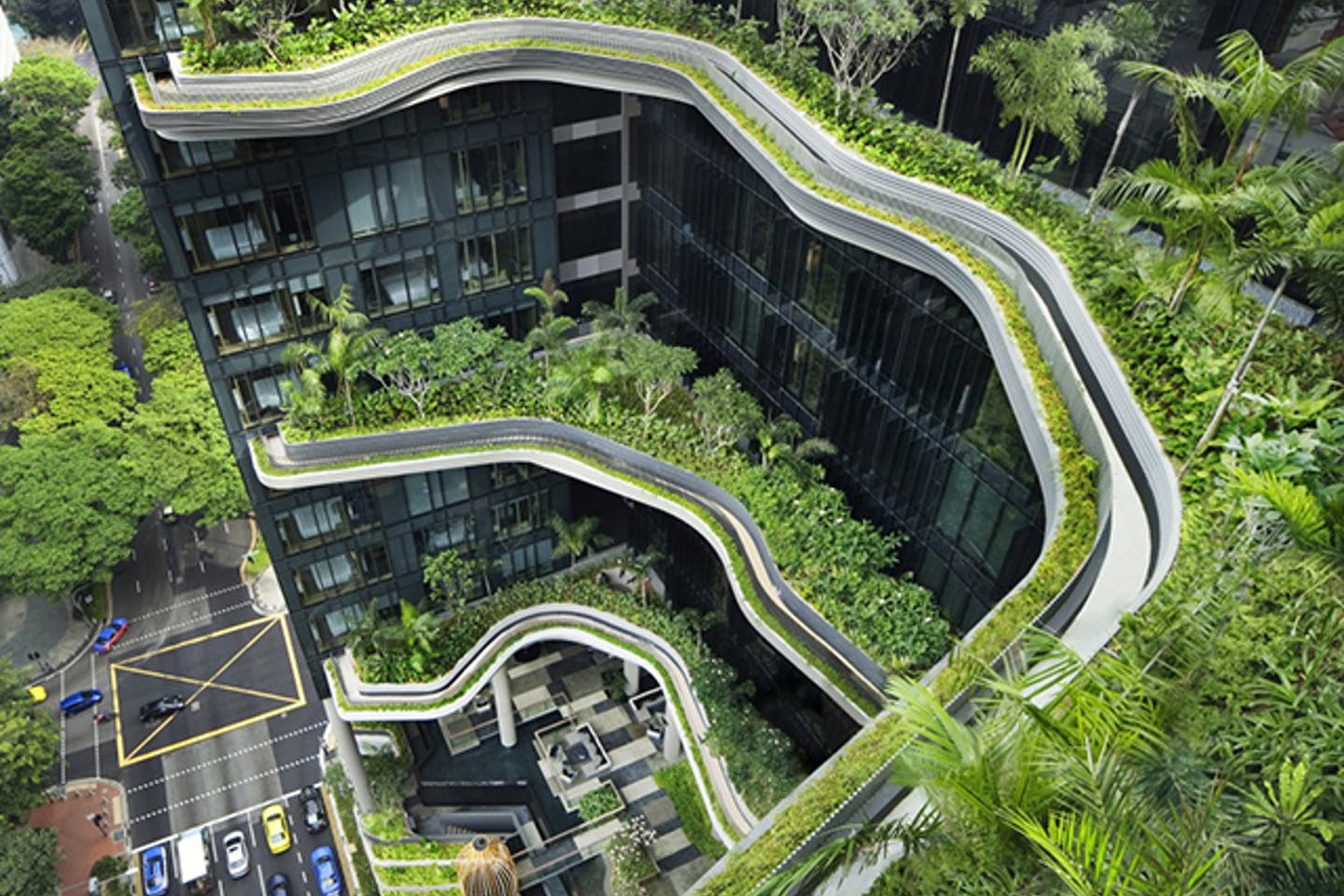
Green building ParkRoyal in Singapore. Source: https://www.eco-business.com/news/one-firms-mission-help-buildings-go-green/
Sustainable urban development not only brings many benefits to human life but also acquires development of various eco-social units and other values. The sustainable urban development contributes to boosting process toward achievement of millennium sustainable development goals, in which there is to end poverty and hunger.
Nevertheless, it has shown that, growing population by immigration has got impacted on sectors of urban development. Indeed, a fast growth of immigrant population makes pressure upon planning residential areas, accompanying utility infrastructures and creating new jobs, increasing rich-poor division. Equality of accessibility among social levels of urban residents to social services is hard to get managed. A rapid growth of immigrant population also leads to housing issues; demand of housing increases when supply source is in a limitation that leads to scarity, forcing prices, pushing prices extremly high compared to real values, contributing to inflation and impacting the whole economy. Besides, crowded cities makes negative impact on people’s life quality, experiencing stress and depression mentally and physically are unavoidable. Serveral social researches taken place at developed cities in the world shown that, overcrowded cities often have higher levels of stress, depression, aggression, and crime rate (Regoeczi, 2008)[1].
[1] https://open.lib.umn.edu/socialproblems/chapter/14-3-problems-of-urban-life/
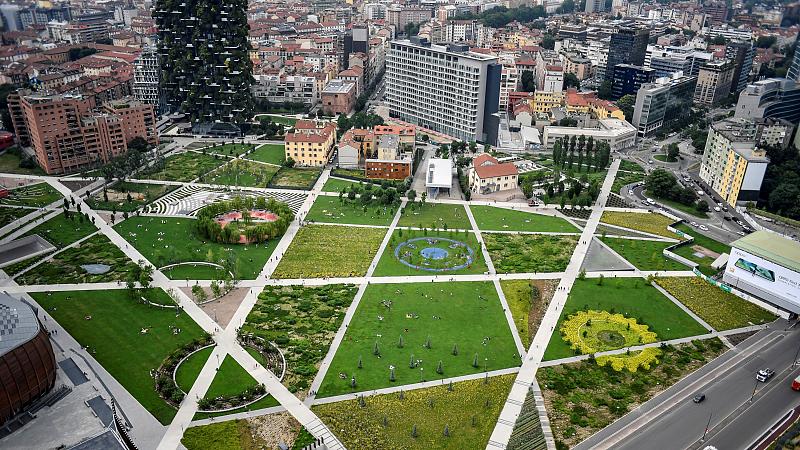
The Library Park of green plants at Milan of Italia. Source: https://www.euronews.com/green/2021/07/13/3-million-trees-and-roof-top-gardens-european-cities-in-green-pledge
In Vietnam, Decision 153/2004/QĐ-TTg dated August 17th 2004 launching Strategic Orientation on sustainable development in Vietnam has been a legal base for implementation of sustainable development of the nation in the 21st century. With the principle that people are center of sustainable development, the Orientation identifies priviledged activities for sustainable development as below: i) Review the master plan to guarantee sustainable development of urban cities; ii) minimize impacts of urbanization upon environment; iii) guide immigrant flows according administrative territories and rural-urban areas. Among them, comprehensive development of economy is the most sustainable measure to manage navigation of immigrant flows, innovation, and operation of immigrant policies[1]. In Vietnam, sustainable urban development has focused on such elements as strategic character of urban master plan, participation of locals and related parties for comments, location identification of urban areas (in harmony with geography, natural conditions, regional development status, eco-trade, society, tech and science, environment, culture, history, etc.), convenience of connecting transportation, synchronous infrastructure, establishment of forecasting and preventing natural disasters.
In 2009, Decision 1448/QĐ-TTg approved adjustment of the master plan of Hai Phong City by 2025, vision to 2050. On January 24th 2019, Resolution 45-NQ/TW was issued on construction and development of Hai Phong City by 2030, vision to 2045. Accordingly, by 2025, Hai Phong would basiscally complete industrialization and modernization; by 2030, to become a modern, smart, sustainable industrial city scaled in Southeast Asia, and vision to 2045 to become a developed city among leading cities in Asia and globally. Those targets posed requirement of adjusting the city’s master plan as a basis for building urban management tools and implementing construction investment projects and the city’s urban spatial master plan./.
[1] https://thuvienphapluat.vn/van-ban/Bo-may-hanh-chinh/Quyet-dinh-153-2004-QD-TTg-Dinh-huong-chien-luoc-phat-trien-ben-vung-Viet-Nam-Chuong-trinh-nghi-su-21-Viet-Nam-52318.aspx