
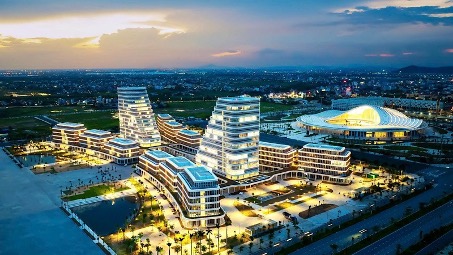
The new administrative and political center of Hai Phong city (Source: Nguyen Duc Nghia)
- Socio-Economic Development Results in 2025 In 2025, amidst complex global developments, trade tensions, and retaliatory tax policies from major countries which imposed significant pressure, Hai Phong City successfully overcame challenges to achieve numerous positive results. Key tasks were implemented as follows:
- Macroeconomic Stability and Growth: The city's economy maintained basic stability, staying close to the set growth targets. Production and business experienced highlights thanks to proactive decisions, strategic negotiations, and a deep international integration process. Hai Phong continued to reaffirm its position as the international industrial, service, logistics, and seaport hub of the Northern Coastal region.
- Administrative Reform and Organizational Apparatus: This was the most breakthrough task of 2025, as the city drastically implemented an administrative reform revolution, rearranging the government apparatus according to a 2-tier local government model. This aimed to create a lean apparatus, enhance state management efficiency, and generate a strong transformation in leadership and administration to serve citizens and businesses.
- Regional Linkage Role: The city maintained its role as a key growth pole in the Hanoi - Hai Phong - Quang Ninh economic triangle. Development orientations were clearly established based on high-tech industry, modern services, smart cities, and green growth.
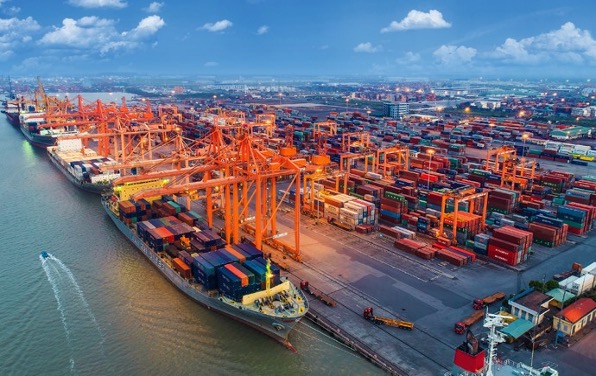
Piers No. 5 and 6, Lach Huyen Port (Source: Collected information)
- Assessment of Impact and Linkages The success of Hai Phong in 2025 did not stem from isolated efforts but resulted from the mutual interaction between tasks:
- Linkage between the Apparatus and the Economy: The implementation of the 2-tier government model acted as "leverage," allowing economic decisions to be executed quickly and reducing administrative barriers for businesses, thereby promoting production and trade.
- Linkage between Infrastructure and Position: Leveraging the advantages of international seaports and logistics reinforced the city's "locomotive" role in regional linkage, attracting strategic investment capital.
- Gains between Growth and Sustainability: The green growth orientation is closely linked to improving people's quality of life and developing the characteristic culture of the "Port land," ensuring economic development remains inseparable from social values.
- Limitations and Causes Despite many achievements, the socio-economic situation in 2025 still faced constraints:
- Shortcomings: Pressures from inflation, exchange rates, interest rates, and instability in the financial-real estate market persisted. Some production activities were affected by trade tensions and retaliatory tax policies from international markets. Additionally, extreme natural disasters and climate change directly impacted the locality.
- Causes: Objectively, these resulted from intense strategic competition between major powers and abnormal global climate volatility. Subjectively, the unpredictable and complex nature of the international context exceeded conventional forecasting scenarios.
- Solutions and Orientations for 2026 To overcome shortcomings and create momentum for the 2026-2030 period, the city has identified key solutions:
- Proactive Execution and Promoting Motivation: Effectively operate the 2-tier government model to ensure leanness and efficiency. Implement the 2026 theme: “Proactive execution; promoting motivation; breakthrough growth”.
- Growth Model Innovation: Shift strongly toward a digital economy (aiming for 31% of GRDP), green economy, and marine economy. Science, technology, and innovation are the focus of development.
- Strengthening Infrastructure and Regional Linkage: Develop synchronous strategic infrastructure, especially multimodal transport systems and modern seaports. Promote Red River Delta linkages to exploit economic corridors connected to the Capital.
- Resource and Environmental Management: Enhance discipline in budget revenue and expenditure, and effectively utilize public investment for key projects. Proactively respond to climate change through forecasting technologies and mangrove protection.
The year 2025 laid a solid foundation for apparatus reform and strategic orientation. With the determination for "breakthrough growth," Hai Phong confidently enters 2026 with the goal of becoming a modern, civilized, and ecological industrial seaport city of Southeast Asian stature.