
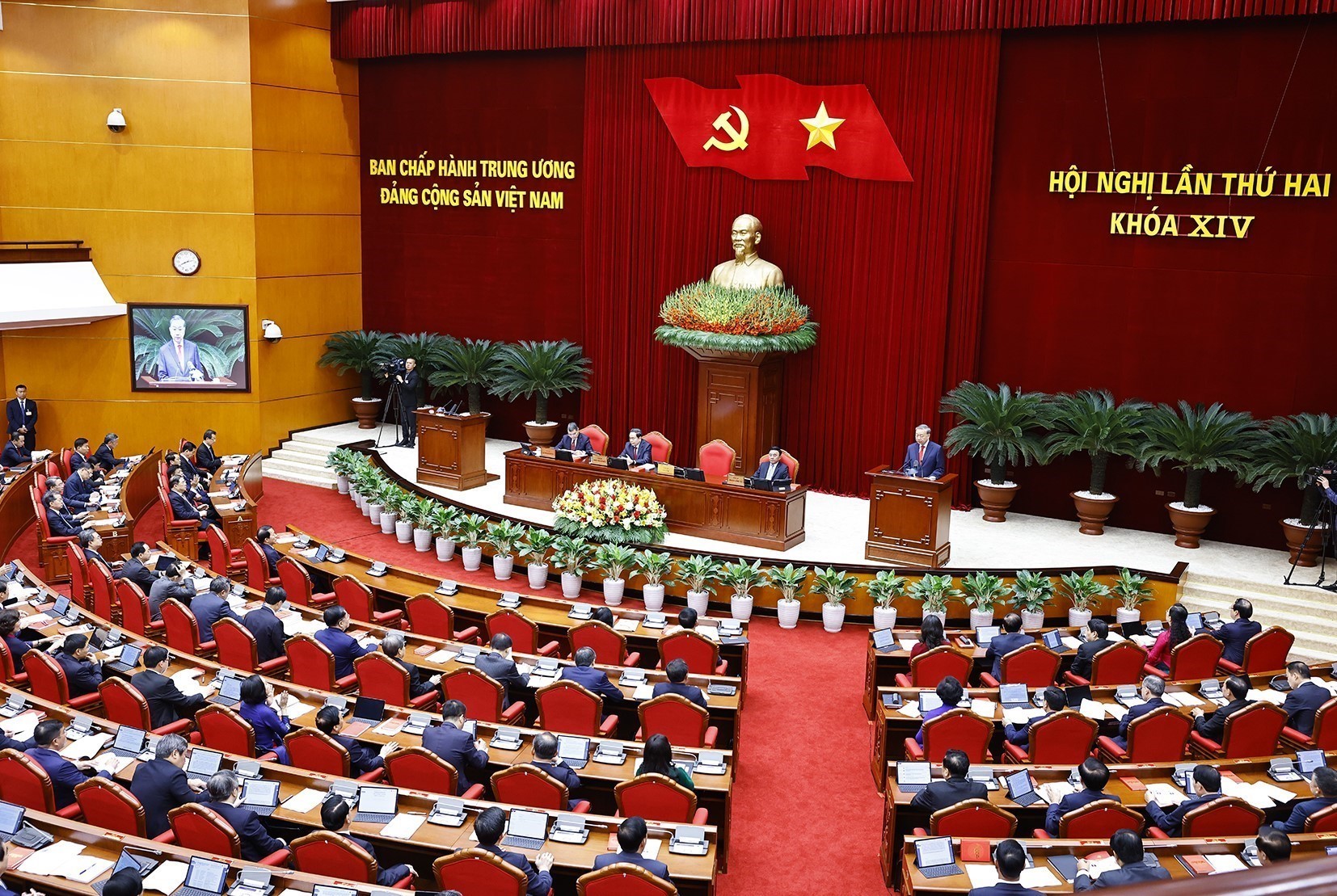
From March 23 to March 25, 2026, in Hanoi, the 14th Party Central Committee successfully organized its Second Plenum to discuss and decide on key contents for implementing the Resolution of the 14th National Party Congress. Chaired by General Secretary To Lam, the plenum focused on working regulations, the 2026–2030 socio-economic development plan, personnel work, and the perfection of the political system's organizational structure.
- Perfecting the Party's Legal Framework and Working Regulations
A vital result of the Plenum was the basic approval of the working regulations for the Central Committee, the Politburo, and the Secretariat of the 14th term. These new regulations inherit core contents from the 13th term while adding new points to increase the responsibility and authority of heads and promote decentralization and the delegation of power. This aims to reform working styles, enhance national governance efficiency, and ensure strict power control.
Simultaneously, the Central Committee approved regulations on the implementation of the Party Charter and the Party's inspection, supervision, and discipline work. Notably, the Central Committee decided to pilot the establishment of Party committees for the non-state enterprise sector in communes and wards with many Party organizations to improve leadership capacity within the private economic sector.
- 2026–2030 Socio-Economic Strategy: "Double-digit" Growth Aspiration
The Central Committee reached a high consensus that the 2026–2030 period is the decisive time for Vietnam to complete the nation's 100-year strategic goals. The core objective is to strive for "double-digit" GDP growth from the very first years of the term. To achieve this, four core principles were identified:
- Economic growth must be accompanied by quality based on Total Factor Productivity (TFP) and innovation.
- Steadfastness in maintaining macroeconomic stability and inflation control.
- Effective mobilization of all resources, focusing on national key projects with high spillover effects.
- Ensuring social justice and improving the people's lives through sustainable welfare policies.
Furthermore, the Plenum agreed on the policy to establish Dong Nai City as a centrally-governed city, a strategic decision intended to drive development for national key economic regions.
III. Breakthroughs in Organizational Structure and Ideology
A significant turning point approved by the Plenum is the transition of Vietnam Television (VTV), the Voice of Vietnam (VOV), Vietnam News Agency (VNA), the Vietnam Academy of Social Sciences (VASS), and the Vietnam Academy of Science and Technology (VAST) from Government agencies to units under the Party Central Committee. This shift ensures the Party's unified, absolute, and direct leadership over major press and strategic research agencies. It also aims to improve the quality of strategic decisions and protect the Party's ideological foundation in the new media environment.
Regarding political and ideological work, the Central Committee institutionalized the "4 Steadfastnesses": Steadfastness in Marxism-Leninism and Ho Chi Minh Thought; Steadfastness in the goals of national independence and socialism; Steadfastness in the Party's renovation line; and Steadfastness in the Party's organizational and operational principles.
- Determination in Anti-Corruption, Waste, and Negativity
The Plenum affirmed that the fight against corruption and negativity has made powerful progress, contributing to strict discipline and a cleaner Party. In the coming period, the Party commits to the motto "no forbidden zones, no exceptions" in this struggle. Key tasks include:
- Strict power control through the completion of synchronous institutions and laws.
- Promoting digital transformation in the Party Inspection sector.
- Implementing a culture of integrity among cadres and members, especially heads of agencies.
- Expanding international cooperation in asset recovery.
- Personnel Work and Preparation for the New Term
The Central Committee reached a high consensus on the personnel to be introduced to the first session of the 16th National Assembly for election to key state leadership positions for the 2026–2031 term. Additionally, Nghiem Xuan Thanh, a member of the Central Committee and Secretary of the Khanh Hoa Provincial Party Committee, was elected as a member of the 14th Central Inspection Commission. These decisions ensure inheritance and stability for the strategic goals of the 14th Congress.
Conclusion: A Call for Solidarity and Strategic Autonomy
At the conclusion of the Plenum, the Party Central Committee called for increased solidarity and unity of will and action under the motto: "Strategic Autonomy - Steadfastness in 100-year strategic goals - Unity, determination, and fierceness for the prosperity and happiness of the People". Party committees and organizations are responsible for turning these resolutions into quantitative results that contribute to the cause of building and protecting the socialist Fatherland.