
On November 15, 2020, Vietnam and 09 member countries of ASSEAN, and 05 countries including China, Australia, New Zealand, Japan and South Korea did sign in the Regional Comprehensive Economic Partnership (RCEP).

Countries participating in RCEP.
Source: Ministry of Foreign Affairs and Trade of New Zealand.
Some features regarding to the RCEP:
- One, population in the participants of the RCEP takes account of above 2.3 billion in a total of above 9 billion of the world’s population, and covers markets scaled $24.8 trillion (WTO Center and Integration, VCCI, 2020).
- Two, China, Australia, New Zealand, Japan and South Korea did sign their proper free trade agreements with ASEAN, such as ACFTA between China and ASEAN, AANZFTA between Australia, New Zealand and ASEAN, AJCEP between Japan and ASEAN, AKFTA between South Korea and ASEAN.
- Three, RCEP was proposal of ASEAN at the Summit 21 in Phnom Penh of Cambodia[1] (in November of 2012) in order to enhance approachability to markets in Asia-Pacific.
- Four, in 2019, India announced to not participate in RCEP due to its concerns on potential negative impacts to its domestic agricultural and industrial fields caused by imported goods from country members of RCEP. According to World Integrated Trade Solution (WITS), in 2018, trade deficit between India and countries in Eastern Pacific was about $153 billion[2]. If India entered RCEP, a higher probability would occur in trade deficit between India and RCEP’s participant countries, particularly between India and China with exported goods from China.
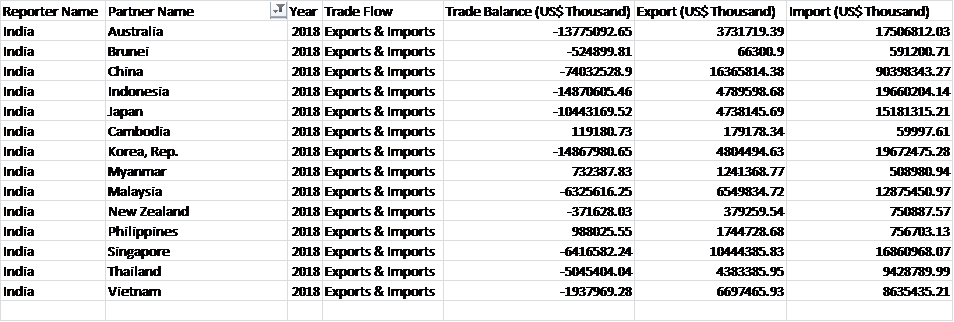
Trade deficit between India and RCEP’s participant countries in 2018.
Source: WITS
With more than 30 negotiation rounds implemented since the first round taken in 2013, the countries focused on negotiating issues in goods trade, services trade, investment, cooperation in economic and technical terms, intellectual property, digital trade, dispute resolution, affairs related to small and medium sized enterprises, and other issues (ASEAN, 2019)[3]. Participation in RCEP consists of both opportunities and challenges.
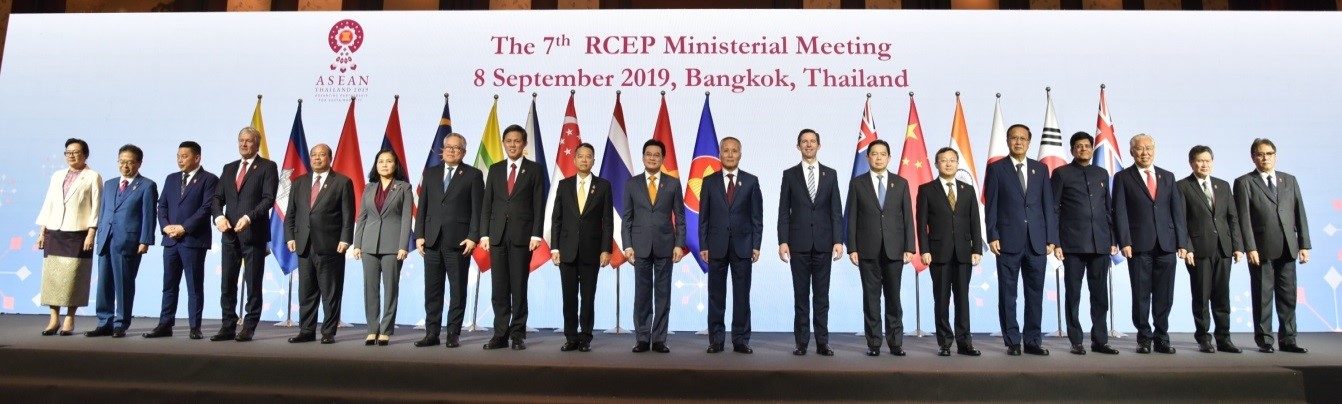
The 7th RCEP Ministerial Meeting at Bangkok of Thailand. Source: ASEAN
CHALLENGES FROM THE RCEP
There are discrepancies in economic development, tariffs, culture, legal systems, politics, etc. among the countries participating in RCEP.
Such different levels on economic development is revealed through gaps in economic growth and income. According to the World Bank, GDP per capita of participant countries of RCEP made remarkable increases from 2010 to 2019. However, there was significant gaps in income.
Compared to the 05 non-Asian countries, GDP per capita of Vietnam has been still modest. For instance, in 2000, GDP per capita in Vietnam reached to about $390; then to 2019, GPD per capita in Vietnam did grow about 7 times to achieve $2,700. Though, a big gap in income has occurred between Vietnam compared to Japan, South Korea, China, Australia, and New Zealand.
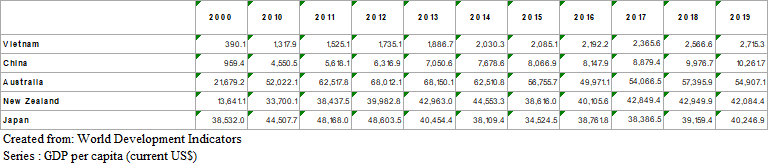
GDP per capita of Vietnam, China, , Australia, New Zealand, Japan in the period of 2000-2019. Source: World Bank[4].
If being compared to 09 ASEAN member countries participating in RCEP, GDP per capita of Vietnam was just higher than Laos, Cambodia and Myanmar with slight amplitudes. From 2010 to 2019, GDP per capita of Vietnam was ranked fourth from the bottom in the list of 10 countries in ASEAN participating in RCEP. Singapore still kept the top and Brunei Darussalam took the second from the top in the list of income ranking of the 10 ASEAN countries.
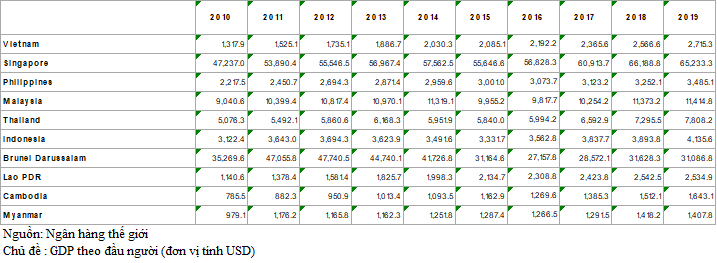
GDP per capita in Vietnam in comparison to GDP per capita of 09 countries in ASEAN in 2010-2019. Source: World Bank[5]
In addition, some countries in RCEP have been strong in importing and exporting goods and services. According to the World Bank, in 2010, exported goods and services of China, Singapore, Japan and South Korea gained about $1,655 billion, $475 billion, $857 billion, and $539 billion respectively. According to the World Bank, exported goods and services of Vietnam multiplied triple in 2019 compared to 2010, that was $279 billion and still humble in comparison with China, Singapore, Japan and South Korea. For instance, in 2019, exported goods and services of China and Singapore reached to above $2,600 billion and $646 billion respectively. Facing strong competition from Chinese and Australian exported goods, Singaporean and Malaysian big companies running business for years in exporting terms, etc., manufacturing and service industries at such developing country as Vietnam would confront to more challenges in terms of investment, technique, quality of goods and services, etc.
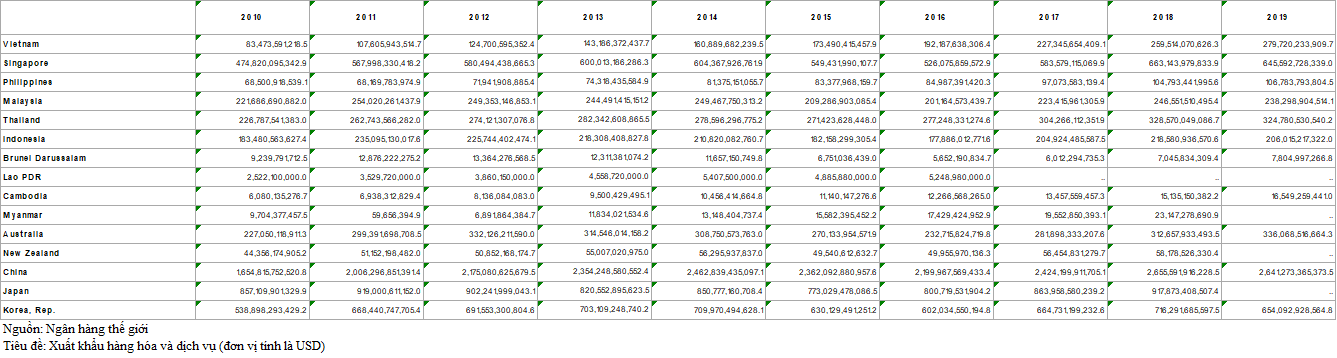
Comparison between Vietnam and the countries signed the RCEP in exports of goods and services. Source: World Bank[6].
In term of language, English has been spoken popularly in trading markets. For instance, communication by English has been taken amongst small and medium sized enterprises in many participant countries of RCEP. Meanwhile, speaking English in small and medium sized enterprises in Vietnam have been at a modest level. The latter has been also a factor impacting capability and effectiveness of integration of Vietnam into regional economy and other free trade playgrounds at the region.
Plus, differentiation in legal systems amongst the countries in the RCEP have made an obstacle to technical barriers related to legal affairs, public procurement, intellectual property, traceability of goods, etc. that can affect ability and efficiency of operation, management, inputs and outputs measure of domestic manufacturing and entering regional and global value chains.
OPPORTUNITIES FROM THE RCEP
According to forecasting from the World Bank, GDP of the countries signing in the RCEP would be expected to grow 1.5% and it would take time for the countries to cultivate benefits from the RCEP (Michael J. Ferrantino, Maryla Maliszewska, Svitlana Taran, 2019)[7]. Though, it needs to have an optimistic view on opportunities brought by RCEP. That is, through RCEP, exporting goods of Vietnamese enterprises will be strengthened, exported seafood and agricultural products will approach to bigger markets while imported goods with appropriate prices and good quality will go into hands of Vietnamese consumers. Moreover, RCEP will make contribution to streamlining custom procedures and products’ origin tracing that then will make reduced bureaucracy (if any) and facilitate participation of small and medium sized enterprises in regional and global markets[8] , despite concerns about competitions and domestic products’ quality in comparison to imported goods from outside. In other words, opportunities have gone aligned with requirements to domestic companies for their enhancement in awareness about RCEP besides CPTPP and EVFTA in order to effectively catch up benefits brought by RCEP./.
[1] ASEAN, “Regional Comprehensive Economic Partnership”, 08/8/2020, https://asean.org/?static_post=rcep-regional-comprehensive-economic-partnership
[2] WITS, “India exports, imports and trade balance By Region 2018”,exceeded on 08/8/2020, https://wits.worldbank.org/CountryProfile/en/Country/IND/Year/2018/TradeFlow/EXPIMP/Partner/by-region#
[3] ASEAN, “RCEP”,https://asean.org/?static_post=rcep-regional-comprehensive-economic-partnership
[4] https://databank.worldbank.org/reports.aspx?source=2&series=NY.GDP.MKTP.CD&country=VNM,CHN,AUS,NZL,JPN
[5] https://databank.worldbank.org/reports.aspx?source=2&series=NY.GDP.MKTP.CD&country=VNM,THA,PHL,MYS,SGP,LAO,KHM,MMR,IDN,BRN#
[6] https://databank.worldbank.org/reports.aspx?source=2&series=NE.EXP.GNFS.KD&country=VNM,JPN,KOR,THA,PHL,MYS,SGP,LAO,KHM,AUS,NZL,MMR,IDN,CHN,BRN
[7]http://documents1.worldbank.org/curated/en/171731585114146413/pdf/Actual-and-Potential-Trade-Agreements-in-the-Asia-Pacific-Estimated-Effects.pdf
[8]According to Vietnam Briefing, Vietnam SMEs accounts for about 98% of the domestic enterprises, contributing to 40% of national GDP and providing 1.2 million jobs at the domestic market. Exceeded on 26/11/2020 at https://www.vietnam-briefing.com/news/vietnam-issues-investment-incentives-smes.html/