
Being considered as a gate of Europe, the Netherlands has owned world-ranking logistics center that has facilitated trades and goods transportation to markets across the world. Besides Schiphol airport (connected to over 300 destinations globally), high-speed railway, waterway, and modern roadway linking to other countries in the European region, the Netherlands has been well-known with its world-leading quality service ports system. Rotterdam Port of the Netherlands has been recognized as the biggest deep-sea port in Europe, the sixth biggest port in the world thanks to goods volume transferred through the port annually.

Rotterdam Port (the Netherlands) viewed from above. Photo source: https://www.portofrotterdam.com/en/taxonomy/term/128?page=1
Some features of Rotterdam Port:
- Rotterdam Port has made a contribution of 7% to the GDP of the Netherlands.
- Rotterdam Port has been home to many oil refining, chemical and gasoline companies.
- Rotterdam Port has owned quality logistics services with fast express that has facilitated goods transfer on inland waterways and international maritime lines.
- Rotterdam Port has applied digitalization for the port management and operation, pursuing neutral CO2 target in infrastructure and energy fields.
Rotterdam Port has been managed and operated by Rotterdam Port Authority, with more than 1,000 employees and revenue gained over 700 million euros (2019)[1].
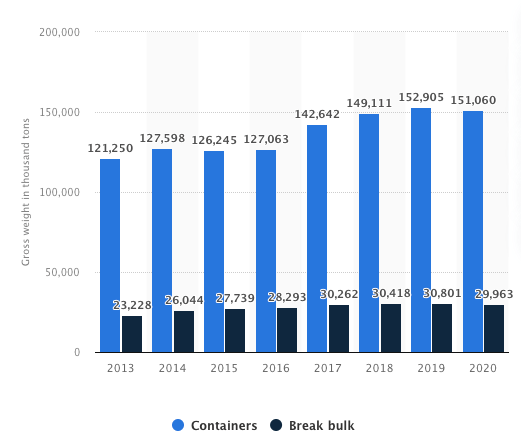
Gross weight of goods processed at Rotterdam Port (the Netherlands) in the years of 2013 – 2020: goods in containers increased from over 120 million tons (2013) to over 150 million tons (2020). Photo source: https://www.statista.com/statistics/914372/volume-of-general-cargo-processed-by-port-of-rotterdam-by-type/
With advantages of geographical location, modern infrastructure, long history in commuting trade, Rotterdam Port is able to receive conveniently large tonnage ships in and out the port. According to statistics of Statista, during the period of 2013-2019, goods volume processed at Rotterdam Port sharply increased. Number of containers and cargoes processed was at peak in 2019, with about 153 million tons of containers and around more than 30 million tons of cargoes processed at the port[2]. In 2020, Rotterdam Port’s net revenue achieved approximately 715 million euros (Statista, 2020)[3].
With advanced maritime infrastructure and transportation and logistics service liberalization, Rotterdam Port has been ranked as one of logistics hubs. European Logistics Centers (ELCs) are located in the Netherlands, serving not only multinationals but also SMEs. An advantage of the ELCs is that goods stored at the ELCs has been considered goods in transit (it means: goods are not yet imported into the Netherlands), thereby goods stored at the ELCs do not suffer from import taxation nor customs procedures. To meet increasing demands of goods owners and delivery service suppliers, distribution parks are located in Rotterdam Port. Arrangement of those distribution parks in Rotterdam Port has helped strengthen goods containers transport capacity, create more jobs related to the port, cut down transferring time with low cost. That is crucial to logistics development at Rotterdam Port. Plus, modern technological application, high-skill labor forces, at-scene customs, distribution parks in Rotterdam Port were established and have been operated since the 1980s- 1990s of the 20th century. Within an area of more than 2,000,000 m2[4], distribution parks are close to the ELCs that have facilitated transport within less time consumption and transport cost. Currently, Rotterdam Port has implemented digitalization and IoT application, with censor equipment establishment in a distance of 42 km2 to connect Rotterdam City to the Northern Sea – on sea and inland, gathering data on tides, temperature, whiffs, and water drafts[5], to optimize efficiency of the port management and operation.

Tan Vu Port (Hai Phong City). Photo: VGP/Trong Tri[6].
Located in Northern coast of Vietnam, with a sea-based economy, Hai Phong City has had 49 ports, including Hai Phong International Container of Lach Huyen Port Area (with a capacity of receiving container ships weigh 14,000 TUES and goods ships weigh 160,000 DWT), Nam Dinh Vu Port (with a capacity of receiving ships weigh 40,000 DWT), Tan Vu Port, Dinh Vu Port, VIP Green Port, Nam Hai Dinh Vu Port, with potentials on logistics. Thanks to advantages of geographic location and infrastructure, inter-regional and international traffic connection that is favorable for the city’s economic development with the logistics industry’s contribution, Hai Phong City has implemented policies and measures to boost logistics. Resolution No. 45-NQ/TW of the Politburo, dated 24/01/2019, on construction and development of Hai Phong City by 2030, vision to 2045, identified the city’s target to become a national logistics center by 2025, an international modern logistics service center on expressway, high speed railway, airway and maritime way, by 2030. Resolution no. 02-NQ/TU of Hai Phong Party Committee’s Standing Affairs Committee noted that, Hai Phong City has to develop services to support port activities, logistic services aligned with potentials, advantages, and development in depth; implement breakthrough mechanisms and policies, attractive investment environment, mobilize and utilize effectively internal and external sources for investment. Hai Phong People’s Committee launched Plan no. 238/KH-UBND on implementing Resolution No. 02-NQ/TU on service activities development to serve port activities and logistics services by 2025, 2030 and vision to 2045. With 06 groups of key tasks including development of connecting seaport and transport infrastructure, development of seaport services and logistics services, improvement of Hai Phong seaport’s competitiveness, development of human resources, enhancement of state management efficiency. To be able to successfully implement the aforementioned tasks, besides implementing mechanisms to facilitate the achievement of above objects, mobilizing domestic and foreign resources is of great significance. In the context of integration, bilateral and multilateral relations with foreign partners, including Dutch ones, have been one of approaches to resources (finance, tech, expertise, etc.) to realize the city’s development goals./.
[1]https://www.marvest.de/en/magazine/ships/the-port-of-rotterdam/
[2]https://www.statista.com/statistics/914372/volume-of-general-cargo-processed-by-port-of-rotterdam-by-type/
[3]https://www.statista.com/statistics/914371/net-revenue-of-port-of-rotterdam/
[4]https://www.unescap.org/sites/default/files/pub_2194_ch4.pdf
[5]https://supplychaindigital.com/technology-4/port-rotterdam-embarks-digital-transformation-programme-ibm
[6]http://baochinhphu.vn/Kinh-te/Dinh-Vu-dua-Hai-Phong-ra-bien-lon/337199.vgp