
2025 marks a historical breakthrough in Vietnam's international integration process. With the issuance of Resolution No. 59-NQ/TW (January 24, 2025) by the Politburo on "International Integration in the New Situation," the Party and State's foreign policy thinking and actions have made significant strides, creating a solid foundation for the country to confidently enter the era of national ascent.
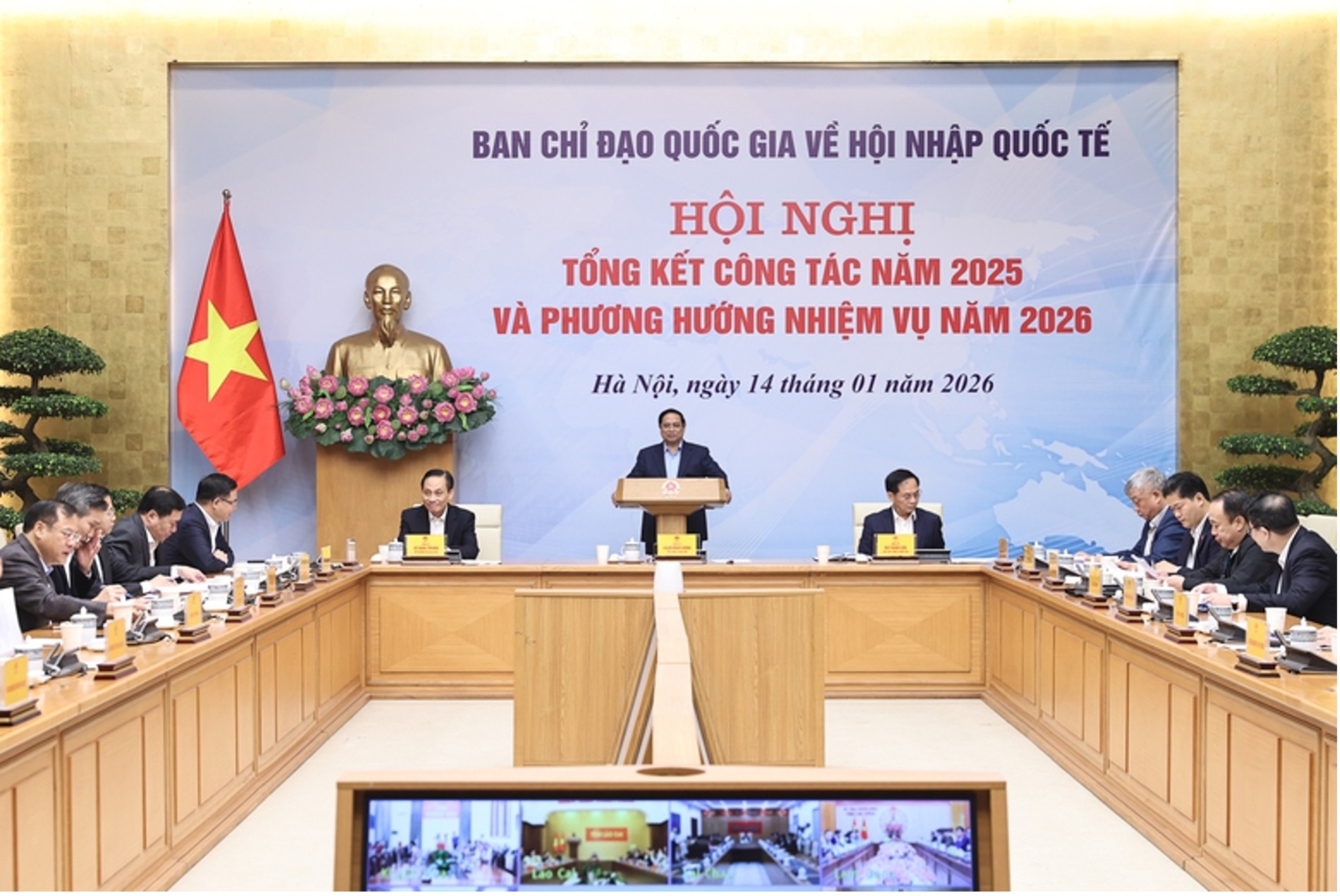
Prime Minister Pham Minh Chinh instructed in the Conference (Source: collected information)
- Breakthrough in Thinking and Perfecting Integration Institutions
Resolution 59-NQ/TW established a new vision, defining international integration as a vital pillar and a key, regular task. A standout feature is the strong shift from a "joining and participating" mindset to one of "building and shaping," ready to take on core and leading roles in issues aligned with national interests.
Subsequently, the Government concretized this through an Action Program based on the "6 Clears" principle (clear people, clear work, clear time, clear responsibility, clear products, and clear authority), implementing 22 targets and 117 specific tasks covering all three pillars: political-security, economic, and socio-cultural. Notably, the National Assembly also passed Resolution 250/2025/QH15 on specific mechanisms and policies to remove bottlenecks and enhance integration efficiency.
- Record Achievements and Stature
In 2025, integration efforts brought substantive results, helping Vietnam affirm its resilience against global "headwinds":
- Economically: Total import-export turnover is estimated at over $920 billion, placing Vietnam among the 15 countries with the largest trade scale in the world. FDI disbursement reached a new record, and the economy's size reached $510 billion, ranking 32nd globally.
- Politically and Diplomatically: Vietnam upgraded relations to Comprehensive Strategic Partnerships with 5 countries (New Zealand, Indonesia, Singapore, Thailand, and the United Kingdom) and Strategic Partnerships with 9 others. Significantly, for the first time, Vietnam has established relations at the Strategic Partner level or higher with all five permanent members of the UN Security Council and all G7 countries.
- Multilaterally: Vietnam affirmed its proactive and leading role by successfully hosting the ASEAN Future Forum, the P4G Summit, and the signing ceremony for the UN Convention against Cybercrime in Hanoi.
- Science and Technology: International integration played a leading role in mobilizing intellectual and external resources for strategic goals such as artificial intelligence (AI), semiconductors, high-speed rail, and nuclear energy.
- Integration Linked with National Defense and Sustainable Development
International integration in 2025 remained inseparable from the task of protecting national interests. Close coordination between foreign affairs, defense, and security has formed an "integrated defense line from afar," helping to protect the country before any threats arise. Simultaneously, border localities have proactively developed border-gate economies and logistics infrastructure, directly consolidating peaceful borders and expanding strategic development space.
- Lessons Learned and Directions for 2026
The success of 2025 provides lessons on combining national strength with the power of the era, placing people and businesses at the center. However, these efforts still face challenges from time-consuming administrative procedures and complex global fluctuations.
Moving into 2026, under the Prime Minister's direction, it is necessary to pivot the situation, transitioning strongly from "expanding relations" to "improving quality and deepening". International integration must truly become a pillar and a driver so that Vietnam not only catches up but also rises to the forefront of new technological fields, realizing the aspiration for a wealthy people and a strong nation by the mid-21st century.
Thanh Huong