
In the project “Enhancing Skills and Employment Opportunities for High-Risk Migrant Workers, Especially Youth at Risk of Human Trafficking,” the Department of Labor, Invalids, and Social Affairs, in collaboration with the International Organization for Migration (IOM), organized a two-day training workshop from March 14 to March 15, 2024. This event aimed to build capacity for teachers and trainers at vocational education institutions in teaching digital skills, soft skills, entrepreneurship, and job-seeking skills.
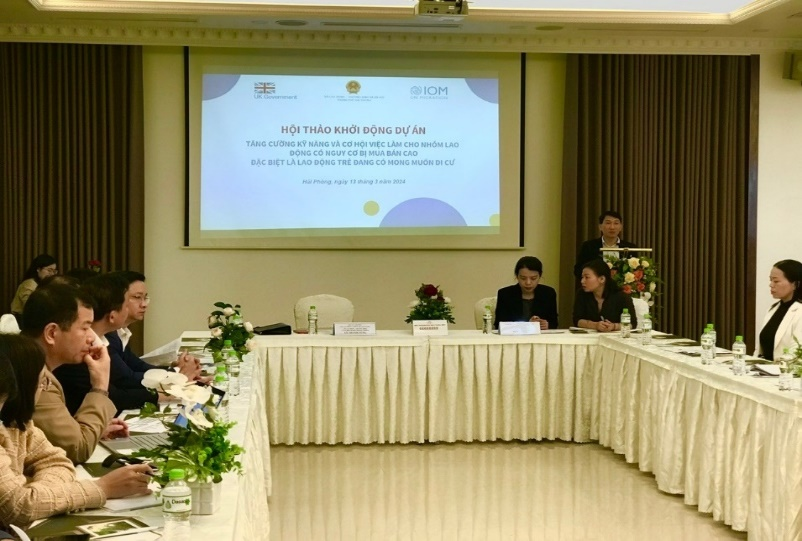
The workshop was attended by 30 educators and trainers from vocational education institutions, representatives from the IOM, and international experts.
In his opening speech, the representative from the Department of Labor, Invalids, and Social Affairs highlighted the importance of developing digital and soft skills in the context of digital transformation and an increasingly competitive labor market. He emphasized that entrepreneurship skills and job-search consulting are essential for helping students build sustainable careers and secure employment.
The workshop covered key course objectives and methodologies, including introductions, setting student expectations, and the core principles of ensuring safety for beneficiaries of the organization and the project. The facilitators discussed the nature of active learning and its application in training, as well as the opportunities and challenges of applying active learning methods within educational institutions. Participants actively engaged in discussions on the effectiveness of teaching methodologies in local schools, as well as the application of active learning principles based on experiences and brain-based activities to design lessons focusing on four essential skill areas: digital skills, soft skills, entrepreneurship, and safe job-searching.
The two-day training ended with the creation of an action plan for the upcoming phases of the project. The workshop facilitated valuable feedback from participants, enabling them to understand the content and teaching methods more effectively. The goal is to help educators integrate these critical skills into their institutions’ curricula and to guide students in acquiring the skills necessary for success in the modern workforce, particularly for those seeking safe and sustainable career paths.