
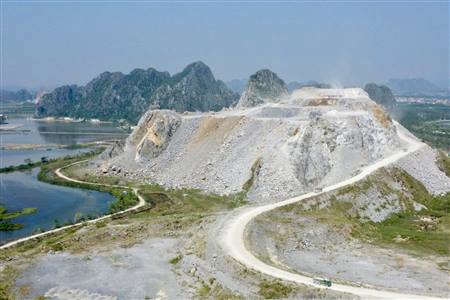
On March 31, 2026, the Hai Phong City People's Committee issued Decision No. 1275/QD-UBND approving restricted and temporarily restricted areas for mineral activities in the Eastern part of the city. This represents a necessary step in the spatial planning strategy, ensuring that resource extraction is integrated with heritage conservation, national security, and sustainable development in the new era.
- Comprehensive Delineation Scale and Scope
Under Decision No. 1275/QD-UBND, Hai Phong has delineated a network of strictly protected areas across 50 communes, wards, and special zones in the Eastern region. The total number of delineated areas reaches 3,246, covering a vast expanse of 108,334.16 hectares.
The identification of these areas is based on a solid legal foundation, including the Law on Local Government Organization 2025, the Mineral Law 2010, and Government Decrees on decentralized management in agriculture and the environment. A delineation map at a 1:100,000 scale accompanying the decision provides a detailed visual overview of the boundaries of these protected areas, serving as a basis for state management of mineral resources.
- Detailed Classification by Strategic Fields
A notable feature of this delineation is the clear separation into 10 specialized fields, reflecting the city’s multi-objective governance mindset. Among the 3,246 areas where mineral activities are prohibited, the specific areas and quantities are distributed as follows:
- Transportation (Largest Area): Accounts for 26,594.68 hectares across 72 areas. This space is reserved for key transportation projects, ensuring safe corridors for the logistics system and regional connectivity of the port city.
- Culture, Sports, and Tourism: Ranks second in size with 47,080.01 hectares (including 607 areas). Prohibiting mineral extraction here aims to protect historical and cultural relics, scenic spots, and ecosystems to serve sustainable tourism development.
- Agriculture and Rural Development: Consists of 51 areas with a total area of 20,260.51 hectares. This includes the strict protection of 17,876 hectares of protected and special-use forests, as well as dyke systems (46 areas) and reservoirs (05 areas) to ensure water security and climate change resilience.
- Defense and Security: This group has the highest number of sites, with 1,016 defense areas(5,171.13 hectares) and 441 security areas (366.82 hectares). This delineation is a key task to ensure a solid national defense and people's security posture in the city's Eastern region.
- Other Technical Infrastructure: Includes 683 information and communication areas (mainly BTS stations); 63 industrial and commercial areas (fuel depots, substations, power plants); 17 construction areas (water supply and wastewater treatment plants); and 272 religious facilities.
- Strategic Goal: Development Linked with Conservation
Decision 1275 is not merely an administrative document but carries deep strategic significance. The core objective of this delineation is to ensure that mineral extraction is linked to environmental protection, natural landscapes, historical-cultural relics, and the maintenance of security and social order.
By establishing these "restricted zones," Hai Phong is creating a transparent resource governance framework that helps prevent illegal mining, land encroachment, and damage to sustainable ecosystems. This is particularly meaningful as the city promotes major projects such as the establishment of the Northern Economic Zone and the transition to a green growth model.
- Implementation Roadmap and the "6 Clears" Responsibility
To ensure the decision is promptly implemented, the Department of Agriculture and Rural Development has issued guidelines for departments, sectors, the City Police, the City Military Command, and People's Committees at all levels regarding dissemination and execution.
The responsibilities of agencies are clearly defined:
- Department of Agriculture and Rural Development: Plays the lead role, coordinating the organization of implementation, disseminating the decision, and synthesizing difficulties encountered during the process. The Department is also responsible for advising on adjustments to restricted areas if the actual situation changes to remain consistent with specialized laws.
- City People's Committee Office: Responsible for publicly posting the decision on the City's electronic information portal for easy access by citizens and businesses.
- Departments, Sectors, and Localities: Based on the delineation results within their managed fields and areas, they are to perform corresponding state management functions. Furthermore, they must proactively provide information, records, and documents to the Department of Agriculture and Rural Development for periodic reviews.
This Decision took effect on the date of signing (March 31, 2026), replacing Decision No. 1784/QD-UBND issued in 2015. This update reflects the city's timely response to new requirements in urban development and resource management for the 2026–2030 period.
The approval of over 3,200 areas restricted from mineral activities in the East is a testament to Hai Phong's determination to build a "Green - Civilized - Modern" city. By prioritizing the protection of forest areas, cultural relics, and strategic transportation infrastructure, Hai Phong affirms its stance of not trading the environment and security for short-term economic growth. This will serve as a solid foundation for the port city to become a safe and sustainable destination for global investors.