
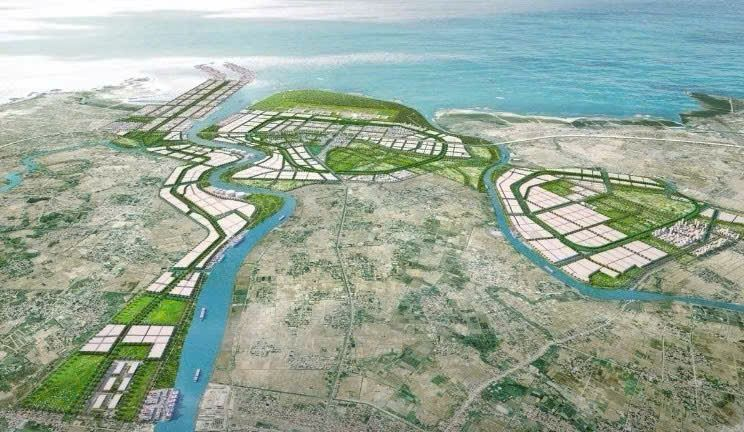
As 2025 begins, Hai Phong’s seaport sector is witnessing increased activity with four new berths (No. 3 to 6) at the Lach Huyen deep-water port coming into operation. This milestone coincides with the formation of new global shipping alliances and the continuous arrival of new vessels, opening up significant opportunities for Hai Phong Port in its journey to become an international transshipment hub.
New Opportunities Emerging
Just days after Berth No. 5 of the Hateco Hai Phong International Container Terminal (HHIT) welcomed its first commercial ship, on February 13, the terminal successfully received the M/V MSC Aurora, a 366-meter-long vessel with a deadweight of 155,000 DWT — the largest container ship ever to dock at Hai Phong Port. This vessel is part of the Chinook service by MSC, the world’s largest shipping line, offering direct connections to the U.S. and Canada. This service opens an optimal shipping corridor from Vietnam to North America, reducing the need for transshipment and optimizing delivery time.
Earlier, on February 8, M/V San Felix under the Gemini TP11 service docked at the same terminal. Operated by the Gemini Alliance (a partnership between Maersk and Hapag-Lloyd), this alliance owns over 340 vessels with a total capacity of 3.7 million TEU. HHIT has been selected as the primary northern Vietnamese port for receiving mother vessels, affirming Hai Phong Port’s growing role in the global supply chain.
As the first deep-water container port in northern Vietnam, Tan Cang Hai Phong International Container Terminal (TC-HICT) is now operating 13 international services, connecting Vietnam directly with markets in the U.S., Europe, and intra-Asia. In 2024, the terminal handled a record throughput of 1.6 million TEU from 471 vessels. In January 2025 alone, TC-HICT received 38 ships, handling 131,015 TEU, with 60% of the volume attributed to direct U.S. services.
To enhance cargo volumes and establish Hai Phong as an international transshipment port, a new service route connecting the Beibu Gulf Port (China) – Hai Phong – Kolkata (India) was launched on February 18. This route strengthens logistics links between Guangxi (China), northern Vietnam, and eastern India/Bangladesh, optimizing logistics costs, shortening delivery times, and enhancing competitiveness. Initially operated every three weeks, the route’s frequency is expected to rise, especially once the Lao Cai – Hanoi – Hai Phong railway line becomes operational.
Strengthening the Supply Chain
According to Mr. Le Quang Trung, Deputy General Director of Vietnam Maritime Corporation (VIMC), Hai Phong Port is becoming a preferred destination for shipping alliances due to its strategic position. The operationalization of deep-water berths at Lach Huyen enables fast connections between Vietnam and key markets in North America, Europe, and intra-Asia. As the main seaport gateway of northern Vietnam, Hai Phong benefits from synchronized transportation infrastructure, and port operators are investing heavily in modern equipment for faster ship turnaround and reduced costs.
However, to establish itself as a global transshipment hub, Hai Phong must strengthen cooperation and open more direct service routes to ports in the U.S., Europe, and Asia. This strategy would cement Hai Phong’s position in international shipping lanes.
Port of Hai Phong JSC, which manages berths No. 3 and 4 at the Hai Phong International Gateway Port (Lach Huyen), is preparing for their April 2025 launch. A critical breakthrough came with the partnership with Terminal Investment Limited (TIL), part of MSC Group, showing MSC’s commitment to shifting transshipment cargo from Malaysian ports to Hai Phong.
Ambitious Expansion Plans
Port investors at Lach Huyen are working intensively to ensure that berths No. 3 to 6 become operational simultaneously in May 2025, while also initiating construction of berths No. 7 and 8 and attracting investment for the remaining berths. Once all eight berths are in operation, the Lach Huyen terminal is expected to handle over 6 million TEU per year.
Additionally, by 2026, Hai Phong plans to begin construction of berths at Nam Do Son Port, further enhancing capacity and connectivity.
Toward Becoming a Regional Hub
With these developments, Hai Phong Port is positioned to become a vital link in the global supply chain and is steadily taking on the form of a regional transshipment hub for Southeast Asia and beyond.