
Besides being a "Seaport Megacity" and an economic growth pole of the entire country, Hai Phong City is affirming its strategic vision in restructuring the agricultural sector toward high-tech, large-scale, and sustainable development. With the advantage of its exceptional people and favorable natural conditions, the local agricultural sector is transforming strongly to increase added value and international competitiveness.
Potential and Strengths of the Coastal Gateway.
Hai Phong possesses fertile agricultural land following the administrative boundary merger, creating significant space for organized concentrated production and specialized cultivation applying modern technology. The tropical monsoon climate with cold winters is an ideal condition for developing high-economic-value winter crops.
- Rice Production: Annually, the city maintains a rice cultivation area of 155,000 - 160,000 ha with paddy output reaching over 1 million tons. Notably, specialty rice varieties such as "Nep cai hoa vang" (Yellow flower glutinous rice) and "Nep quyt" (Tangerine stickly rice) reach an output of 40,000 tons per year. Furthermore, the organic rice model combined with the exploitation of sandworms and sesarmid crabs on an area of over 1,000 ha is providing superior economic value.
- Vegetables for Export: Hai Phong is a vegetable "capital" with a planting area of approximately 63,000 ha. Among these, carrots are a strong product, with about 80% of the output being exported to international markets. Onions, garlic, greenhouse melons, and other winter vegetables also contribute to an output of millions of tons every year.
- Specialty Fruit Trees: With an area of 28,300 ha, the city focuses on developing key crops such as lychees (over 600 ha meeting VietGAP and GlobalGAP standards), longans, bananas, and guavas.
Breakthroughs with Smart Agricultural Models.
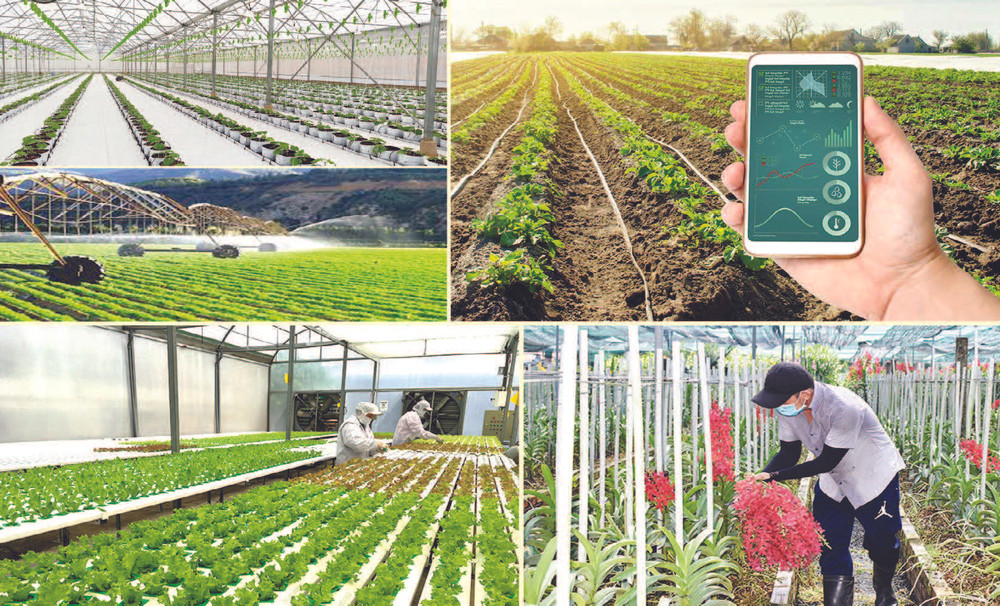
Hai Phong is pioneering the construction of high-tech fields, gradually forming a green and smart agriculture.
- Low-emission Rice Model: In Viet Khe commune, the city has implemented a 46.3-ha high-tech field applying synchronous mechanization and smart water management, which has helped increase productivity by 20-30% while reducing greenhouse gas emissions.
- Automated Livestock Farming: The chicken farming model in Tien Minh commune applies digital technology for environmental monitoring and product traceability, optimizing labor and ensuring biosafety. Currently, the city's total poultry herd has reached over 24.1 million, affirming its leading position in the Red River Delta region.
- Maritime Economy and Fisheries: With a coastline over 125 km long, Hai Phong is the largest fishery logistics service center in the North. The potential aquaculture area reaches approximately 54,600 ha, integrating Industry 4.0 technology for environmental monitoring and warnings to support exports.
Forestry: The "Green Shield" Protecting the City.
The city's forest system, covering an area of more than 22,249 ha, plays a vital role in protecting the environmental landscape and World Heritage sites such as Ha Long Bay - Cat Ba Archipelago. Mangroves are identified as a "biological wall" against salinity intrusion and a natural nursery for aquatic products, linked to sustainable livelihood models under the forest canopy for residents.
Future Development Orientation.
In the coming time, Hai Phong is consistent with the goal of modernizing commodity agriculture toward sustainable organic development. The city plans to maintain stable key cultivation areas and promote circular livestock farming to convert waste into renewable energy, aligning with the "green city" orientation.
The application of gene technology, digitalized seed management, and the expansion of concentrated farming zones will serve as levers for Hai Phong to not only ensure food security but also reach further on the global agricultural export map. The city is committed to accompanying businesses and citizens to create a "modern, civilized, ecological" agriculture, contributing to the realization of the aspiration to become an international-level livable city.