
In the roadmap to implement the National Digital Transformation Strategy, establishing a unified "digital key" for all citizens and businesses is identified as a top priority task. Implementing the latest directives from the Government and the Ministry of Public Security, Hai Phong City is drastically deploying the integration of login via electronic identity and authentication accounts across information systems. This is not only a technological advancement but also a revolution in management thinking, aiming towards a modern, transparent administration that is citizen-centric.
1. Legal Basis and Implementation Context
The promotion of electronic identity account integration is based on a strict and synchronized system of legal documents. The focus is Decree No. 69/2024/ND-CP dated June 25, 2024, of the Government, providing detailed regulations on electronic identity and authentication. This Decree created a solid legal corridor for the issuance, management, and use of electronic identity accounts (eID accounts) for agencies, organizations, and citizens.
Continuing this development momentum, on May 11, 2026, the Prime Minister signed Decision No. 826/QD-TTg approving the Program for the Project on developing the application of population data, identification, and electronic authentication to serve national digital transformation for the 2026-2030 period, with a vision to 2035 (commonly known as Project 06, Phase 2). The Project identifies the eID account as a digital tool, an essential "key" to open the door to the digital world, contributing to the promotion of Digital Government, Digital Economy, and Digital Society.
In Hai Phong, Vice Chairman of the City People's Committee Hoang Minh Cuong assigned the City Police to lead and coordinate with departments, branches, sectors, and localities to urgently review and evaluate systems and platforms to implement login integration using eID accounts according to the technical guidance of the Ministry of Public Security.
2. Purpose of Unified Login Integration
This integration aims at several strategic goals to optimize the operation of the state apparatus and enhance utilities for society:
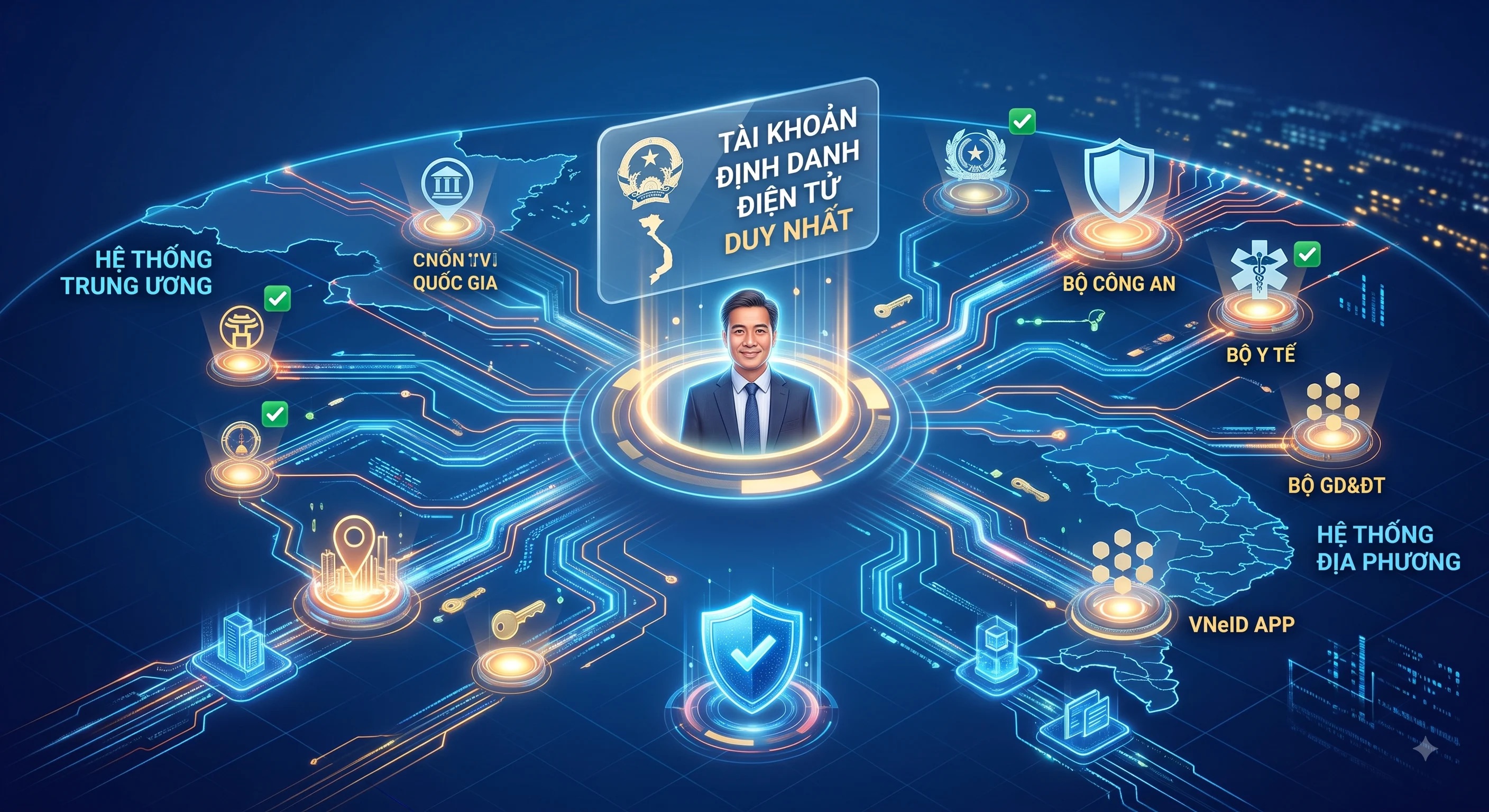
- Establishing "A Single Account": The ultimate goal is to integrate and use a single account for one-time login, allowing seamless access across software and information systems from the central to local levels. This eliminates the situation where each information system of a department, branch, or locality requires citizens to remember a separate set of usernames and passwords.
- Promoting Full-Process Online Public Services: Integrating eID helps simplify application components and reduce various types of paperwork when performing administrative procedures. The system will automatically fill in information and confirm data by exploiting and sharing from the National Population Database.
- Realizing "Administrative Boundary-free" Public Services: When identities are strongly electronically authenticated, citizens can submit applications and perform public services anywhere without depending on administrative boundaries.
- Completing the VNeID Digital Ecosystem: Developing the VNeID application into a multi-utility national digital platform, not only serving administrative procedures but also supporting non-cash payments, social security payments, and acting as an official communication channel between the government and citizens.
The deployment of eID login integration brings great practical value and significance:
For Citizens and Businesses:
- Saving Time and Costs: Citizens do not have to go directly to state agencies, do not have to submit copies of documents, or perform traditional comparison operations.
- Enhancing Security and Safety: Electronic identity accounts are protected by law, ensuring the accuracy and uniqueness of the digital identity. Authentication levels (from level 1 to level 4) are designed to suit each type of transaction, ensuring maximum safety for personal data.
- Accessing Diverse Utilities: In addition to solving administrative procedures, citizens also benefit from utilities in healthcare (Electronic Health Record), education, finance, and e-commerce on the same platform.
For the City Government:
- Improving Governance Efficiency: Using "correct, sufficient, clean, and live" data helps city leaders have accurate information to direct and operate based on real-time data.
- Substantive Administrative Reform: eID integration is the driving force to restructure business processes, cut intermediate steps, and reduce pressure on the team of officials and civil servants.
- Preventing Negativity and Waste: Data digitization and interconnection help prevent document forgery and policy profiteering, ensuring that resources (such as social security support) are allocated to the right subjects.
According to Decision No. 826/QD-TTg, the implementation roadmap is divided into specific stages with clear quantitative targets:
Stage to 2026:
- Strive to increase by at least 10 ranks in the E-Government Development Index compared to 2025.
- The rate of administrative procedures submitted "boundary-free" reaches a high level.
- The rate of Vietnamese citizens issued with identity cards having a level 2 electronic identity account reaches over 80%.
- Develop at least 20 million social security accounts integrated on VNeID.
Stage to 2030:
- Complete the national population data ecosystem with multi-sector interconnection.
- 100% of administrative procedure application processing results are notified of their status and synchronized on VNeID.
- The value of non-cash payments reaches 30 times the GDP.
- 100% of citizens have interconnected electronic health records.
- Vision to 2035: Vietnam will become a sustainably developed digital nation where all transactions between citizens and the government are performed in a digital environment with the population database as the core.
To achieve the above goals, the Ministry of Public Security and the Hai Phong City People's Committee have assigned specific tasks to each unit:
- Ministry of Public Security: As the standing agency, it is responsible for managing and operating the electronic identity and authentication system; ensuring security, safety, and high readiness of the connection system.
- Hai Phong City Police: Leading and coordinating with units to provide technical guidance, urge the implementation process, and synthesize difficulties and obstacles to report to the City People's Committee.
- Departments, Branches, and Localities: Responsible for self-reviewing and evaluating specialized information systems to perform mapping, standardize population data, and integrate eID login according to regulations. Particularly, the Education, Health, Finance, and Banking sectors need to prioritize promoting eID application in regular online transactions for citizens.
The integration of login via electronic identity and authentication accounts is an inevitable and urgent step for Hai Phong in the digital transformation journey. With the drastic involvement of the city's entire political system and the consensus of the people, the deployment of eID accounts will truly become an important "lever," unlocking all data resources and contributing to building Hai Phong into a modern, civilized, ecological, and leading smart port city in the region.