
On the morning of June 10, 2026, at the Cultural Center of Tan An Commune, Hai Phong City, the Department of Agriculture and Environment, in coordination with the Department of Crop Production and Plant Protection (Ministry of Agriculture and Rural Development) and the International Rice Research Institute (IRRI), successfully organized the "Review Conference on Rice Cultivation Models Using Proper Fertilizer, High Efficiency, and Low Emissions in the Red River Delta".
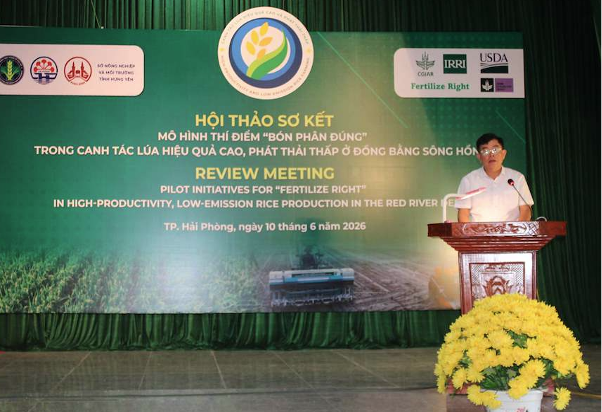
The event attracted over 110 delegates, including representatives from various Departments, Institutes, and Centers under the Ministry of Agriculture and Rural Development; the Departments of Agriculture and Environment and Plant Protection Departments of Hai Phong, Ninh Binh, and Hung Yen; domestic and international experts; and farmers from these three localities.
Implementing High-Efficiency and Low-Emission Models
The high-efficiency, low-emission rice cultivation model is currently being piloted in three provinces and cities in the Red River Delta: Hai Phong, Hung Yen, and Ninh Binh. This activity is part of the "Project for Emission Reduction in Crop Production for the 2025–2035 Period, with a Vision to 2050" and is supported by the "Fertilizer Right" project, funded by the United States Department of Agriculture (USDA).
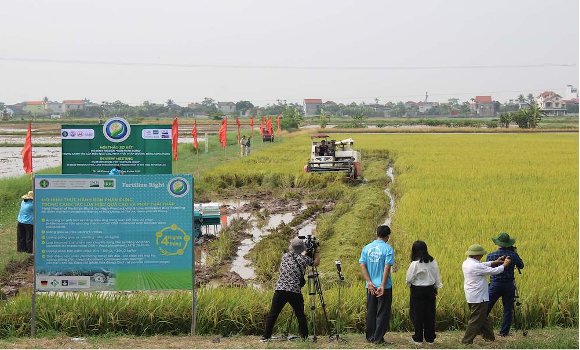
Before the main discussion, delegates visited a field at the Huu Chung Cooperative in Tan An Commune, Hai Phong, to witness a demonstration of combine harvesters. The production model here applies smart fertilization processes, nutrient optimization, and strict water control, yielding highly positive results. The rice not only achieved high yields but also significantly reduced input costs, particularly the amount of chemical fertilizers—the primary source of greenhouse gas emissions in traditional farming.
Impressive Scientific Results
At the conference, Dr. Nguyen Van Hung, a Senior Scientist at IRRI, summarized the impressive results from the pilot models. Scientific data indicated that following the correct technical procedures allowed rice plants to grow well with fewer pests, lower investment costs, and a marked reduction in harmful emissions released into the environment.
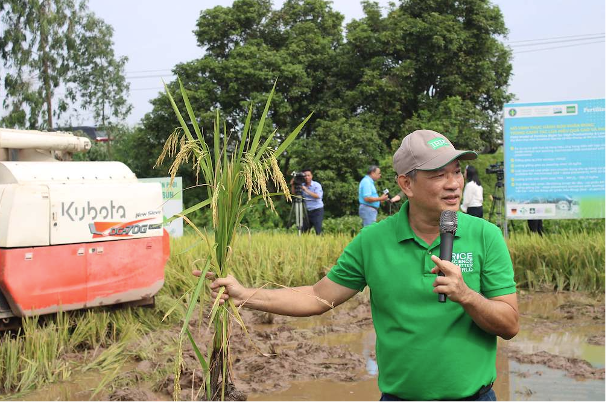
Localities from Hai Phong, Hung Yen, and Ninh Binh shared their implementation results, practical experiences, and lessons learned. The participants discussed technical solutions, support mechanisms, and orientations for scaling up low-emission rice production models throughout the Red River Delta.
The conference fostered professional exchange between regulatory agencies, international organizations, experts, and local authorities. It affirmed Vietnam’s determination to build a responsible, sustainable, and environmentally friendly agricultural sector.