
On March 12, 2026, the Standing Committee of the Haiphong City Party Committee officially issued Action Plan No. 37-KH/TU to implement the Politburo’s Resolution No. 79-NQ/TW on the development of the state economy. This strategic move demonstrates the port city's high political determination to innovate and enhance the efficiency of the state economic sector, creating a breakthrough momentum for Haiphong to become a modern, civilized, and sustainable industrial city of Southeast Asian stature by 2030.
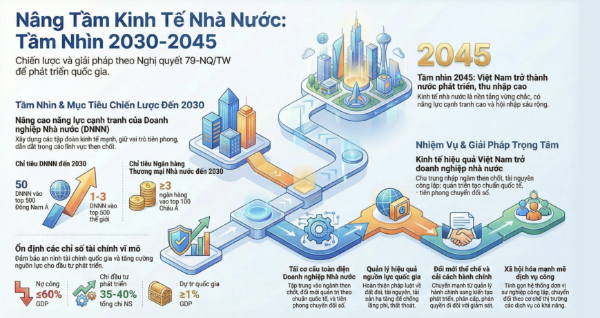
Strategic Vision and Breakthrough Goals
The Action Plan clearly defines the general objective of improving efficiency and promoting the leading, pioneering role of the state economy in key and essential sectors. The state economy is expected to serve as "seed capital," activating social resources and guiding other economic sectors to develop together.
Specifically, Haiphong has set impressive economic targets for the 2026–2030 period:
- Average GRDP growth of 13% per year or higher, with the industry and construction sector increasing by 15.2% per year.
- The budget mobilization rate during this period is expected to reach approximately 18% of GDP.
- By 2030, the city aims to essentially complete the "Environmentally Friendly Service and Business Establishment" model, eliminating single-use plastic products at tourist destinations.
Looking toward 2045, Haiphong aspires to become a highly developed city among the leading group in Asia and the world, featuring modern infrastructure and a high capacity for climate change adaptation.
The "Five-izations" Principle and Management Innovation
A key highlight of Plan No. 37-KH/TU is the rigorous application of the "Five-izations" requirement for state resources: Optimization, Smartization, Harmonization, Greening, and Digitization. The city requires resource management to ensure it is "accurate, sufficient, clean, live, unified, and shared".
To realize this, Haiphong has identified a need for a strong shift in leadership mindset, moving from administrative management to development facilitation. The city is committed to building a fair and transparent legal environment that complies with market rules while minimizing unnecessary administrative interference. Notably, the city emphasizes a mechanism to protect officials who are "daring to think, daring to do, and daring to take responsibility for the common good" to remove practical bottlenecks.
Synchronous Infrastructure and the Blue Sea Economy
Haiphong identifies transportation infrastructure as the "lifeline" of development. The plan proposes the synchronous development of all five modes of transport according to a multi-modal transport model. Key projects will be accelerated, including:
- Completing the berths of the Lach Huyen International Gateway Port.
- Investing in the construction of Nam Do Son Port and the Van Uc River area.
- Expanding and upgrading Cat Bi International Airport.
- Developing coastal waterways to leverage the advantages of river-to-sea transport.
Regarding resource management, Haiphong will focus on a Blue Sea Economy strategy, prioritizing offshore wind power, offshore aquaculture, and fishing in association with national sovereignty protection. The city also aims to be a pioneer in energy transition, limiting the use of fossil fuels and switching to renewable energy.
Reform of State-Owned Enterprises and Public Service Units
State-Owned Enterprises (SOEs) will be restructured to truly become a vital material force. Haiphong strives for 100% of city-managed SOEs to implement management on digital platforms by 2030. The city encourages SOEs to lead in scientific research, innovation, and deep integration into global supply chains.
For inefficient or long-term loss-making investment projects, the city demands an urgent review and definitive resolution, clearly identifying the responsibilities of relevant organizations and individuals to avoid waste and loss of state assets.
Simultaneously, the reorganization of Public Service Units (PSUs) is being implemented drastically. Haiphong will promote the socialization of public services, retaining only units that serve essential political and state management tasks. The goal by 2045 is for at least 50% of city-affiliated PSUs to be self-sufficient in both regular and investment expenditures.
Effective Financial and Budgetary Management
Financially, Haiphong will diversify its capital mobilization channels to ensure balance and debt repayment capacity. The city prioritizes budget allocation for strategic infrastructure projects to create new development spaces.
The plan also emphasizes reviewing and improving the efficiency of extra-budgetary state financial funds. Overlapping or inefficient funds will be dissolved or merged. The city aims to entrust the management of financial funds to banks or professional financial management companies to increase transparency and efficiency.
Implementation and Supervision
To bring Plan No. 37-KH/TU to life, the Haiphong City Party Committee has assigned specific tasks to various levels of party committees, organizations, and functional agencies:
- The City Party Committee's Commission for Propaganda and Education is responsible for guiding communication work to create high consensus among the people.
- The City People's Committee's Party Civil Affairs Committee will direct the formulation of specific implementation plans for each sector and locality.
- The Fatherland Front and socio-political organizations will participate in monitoring and social criticism regarding policies related to state economic development.
The city has also set a specific roadmap for these tasks:
- Complete the establishment of an independent and transparent review process to evaluate official errors by Q4/2026.
- Accurately review land types to adjust planning accordingly by Q3/2026.
- Develop plans to merge or consolidate inefficient PSUs by Q2/2027.
Conclusion
Haiphong's action plan for Resolution 79-NQ/TW is more than just an administrative document; it is a detailed blueprint for the city's future. By focusing on technological innovation, modern governance, and environmental protection, Haiphong is asserting its position as a "connection hub" and a vital growth engine for the country. The transformation of the state economic sector is expected to create a ripple effect, driving the city's entire economy toward rapid, sustainable development and deep international integration.