
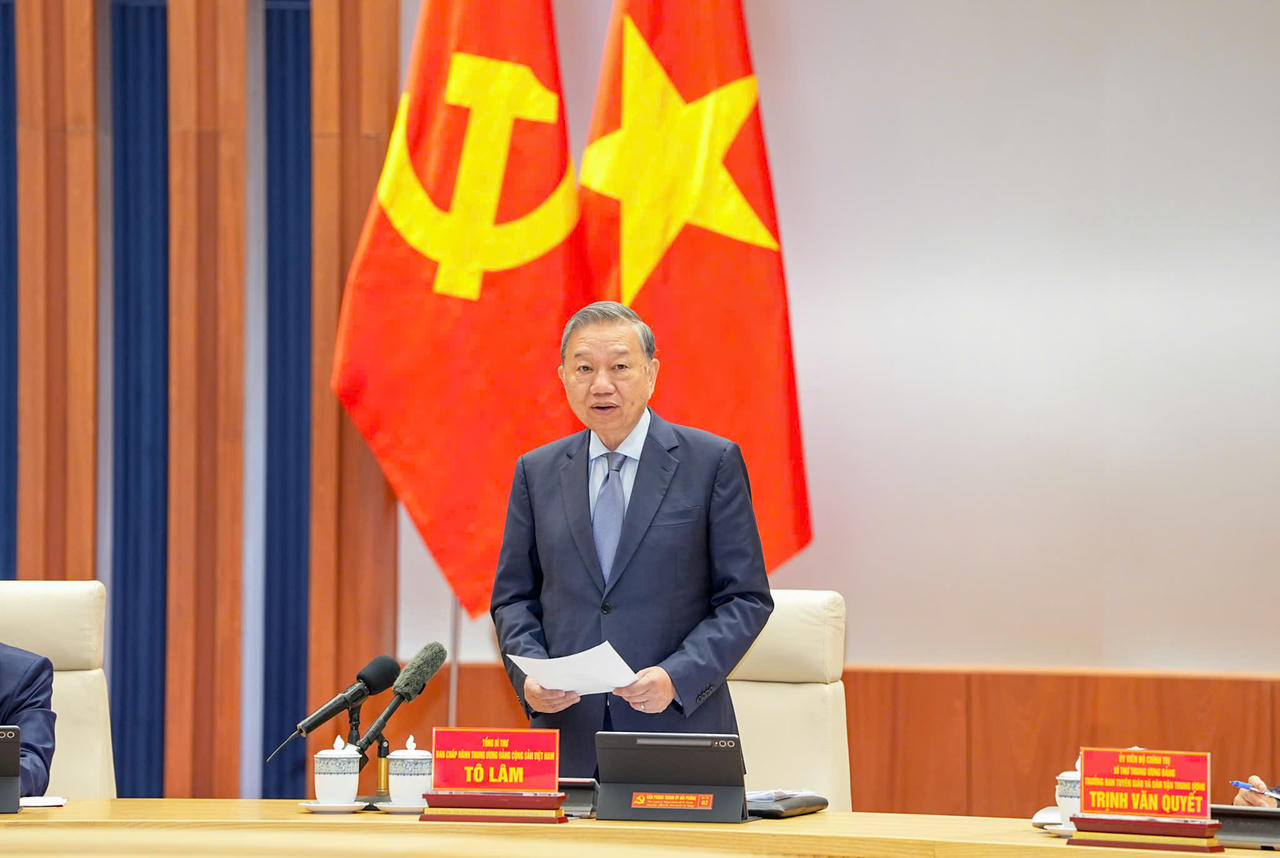
On April 14, 2026, the Hai Phong City People's Committee officially issued Action Plan No. 130/KH-UBND to implement the conclusions of General Secretary To Lam following his working session with the City Party Committee. This is regarded as a "strategic roadmap" with specific tasks to shape Hai Phong's future as a marine economic center, a modern industrial hub, and a globally connected city following the "6 clears" principle: clear people, clear tasks, clear responsibilities, clear authority, clear time, and clear results.
Institutional Breakthroughs and Streamlining the Administrative Apparatus
The top priority identified in Plan 130 is institutional refinement and restructuring the political system in conjunction with administrative reform. Hai Phong is determined to implement the principle of "one agency performing multiple tasks, one task assigned to only one primary responsible agency" to overcome overlaps and duplications. The city will operate a streamlined two-level local government, promoting decentralization and authorization under the motto "localities decide, localities do, and localities are responsible". Simultaneously, digital transformation will be vigorously applied to enhance the quality of grassroots cadres and ensure that administrative reform indexes such as PAR Index and SIPAS remain among the country's leaders.
Industrial Restructuring and Affirming the Status as an International Logistics Center
Plan 130 focuses on industrial restructuring toward modernization, intelligence, and greenification. Hai Phong will continue implementing the supporting industry development program through 2030 and research the construction of eco-industrial clusters. A notable point is the selective recovery strategy for traditional industries such as mechanical engineering, transport, and seaports, particularly the implementation of the Project to research, restore, and develop the shipbuilding industry using clean energy, in line with green transition commitments.
Regarding logistics, the city aims to become a modern international logistics center. Key projects will be accelerated, including completing berths 7 to 12 of the Lach Huyen International Gateway Port before 2030. Other priorities include commencing the Nam Do Son Seaport, developing the Van Uc river area port, and coordinating the implementation of the Lao Cai - Hanoi - Hai Phong high-speed railway to connect directly to seaports. The city will also fast-track the Ninh Binh - Hai Phong expressway and coastal roads connecting key tourist areas like Do Son, Cat Ba, and Ha Long Bay.
Science, Technology, and Digital Transformation: The Primary Growth Drivers
Following Politburo Resolution No. 57-NQ/TW, Hai Phong identifies science, technology, innovation, and digital transformation as the primary drivers of the new growth model. Plan 130 sets the task of investing in and enhancing the capacity of the City's Innovation and S&T Application Center, while researching investment in the Science and Innovation Park. The city will complete the construction of the Smart Operations Center, serving as the "digital brain" of the port city. AI and big data will be widely applied in governance and production. Specifically, the city will prioritize supporting seaport and logistics enterprises in digital transformation to optimize import-export operations.
Resource Mobilization and Promoting the Private Economy
To provide resources for these massive tasks, Hai Phong will tighten budget discipline, striving to allocate at least 60% of budget expenditures to development investment by 2030. The city will also diversify capital mobilization forms through public-private partnerships (PPP) and pilot new financial models such as green finance and urban development investment funds. The private economy is identified as a vital driver, with the task of strengthening connections between domestic private enterprises, FDI enterprises, and state-owned enterprises. A strategic mission is to complete the management and operation mechanism of the Free Trade Zone, creating a favorable environment to attract Fortune 500 corporations to invest in the city.
Spatial Planning and Sustainable Development
Hai Phong will complete and announce the City's General Plan through 2050, with a vision to 2075. New development space will include underground space planning and specialized planning for foundation elevation and drainage to respond to climate change and rising sea levels. The city will also coordinate with ministries to propose content for the Red River Delta Regional Plan, affirming its role as a growth pole in the Hanoi - Hai Phong - Quang Ninh economic triangle.
Social Welfare: Placing the People at the Center of Development
Alongside economic development, Plan 130 emphasizes improving the lives of the people. The city strives to ensure that no multi-dimensional poverty remains for the 2026-2030 period by 2028. Healthcare and education systems will be upgraded according to specialized projects with a vision to 2045. The "Model Worker Accommodation Area" model with full healthcare and education infrastructure directly at industrial zones will be widely deployed. The city also encourages businesses to commit to good wages and benefits, promoting "green jobs" to increase sustainability.
Determination for Effective Implementation
The City People's Committee assigned departments, sectors, and localities to proactively implement tasks based on the plan's content, ensuring quality and progress. The Department of Finance is assigned as the focal point to synthesize and report on implementation status to the City Party Committee Standing Board upon request. Action Plan No. 130/KH-UBND represents Hai Phong's strong commitment to implementing Central directives. With a detailed roadmap and clear assignment of responsibilities for each department, Hai Phong is confidently entering a new era as a leading, modern, and sustainably developed port city.