
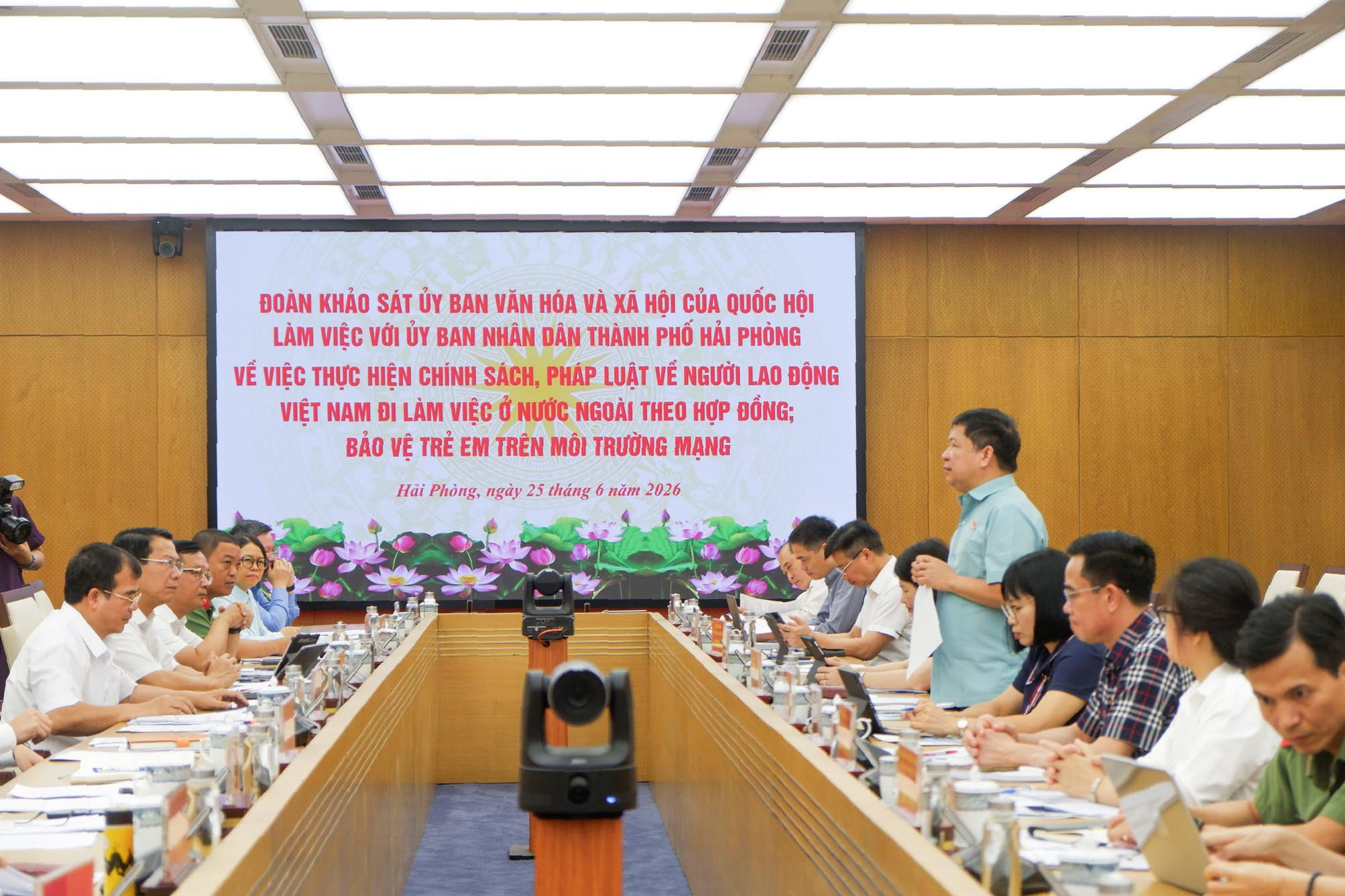
On June 24, 2026, the National Assembly’s Committee on Culture and Education conducted an intensive survey in Hai Phong City to evaluate the implementation of policies and laws regarding Vietnamese laborers working abroad under contracts. This event serves as a timely backdrop for assessing the city's progress in labor export, which has transitioned from a basic employment solution to a strategic mission for socio-economic development and high-quality human resource training.
A Robust Foundation: Policy and Organizational Reform
Hai Phong has proactively integrated the Law on Vietnamese Workers Working Abroad Under Contract (Law No. 69/2020/QH14) into its local governance framework. The city recognized that a modern legal environment requires a shift from rigid administrative management to a "serving administration" that prioritizes the protection of workers' rights and interests.
To solidify this vision, the City Party Committee issued Plan No. 237/KH-TU in April 2023, followed by the People’s Committee’s Plan No. 240/KH-UBND in September 2023. A major milestone in this administrative evolution occurred on March 1, 2025, when Hai Phong designated the Department of Home Affairs as the primary advisory body responsible for state management of overseas labor. This organizational shift aims to concentrate resources and enhance the professionalism of support services, ranging from receiving labor supply reports to assisting returnees with social reintegration.
Statistics and Market Trends (2022-2025)
The period from 2022 to 2025 witnessed a significant recovery and stabilization of labor export activities in Hai Phong. According to official reports, the city successfully sent 44,062 workers abroad during these four years, maintaining an average of approximately 11,015 laborers per year.
Yearly Breakdown of Laborers Sent Abroad: 2022: 16,328 workers; 2023: 16,340 workers; 2024: 14,068 workers; 2025: 12,014 workers.
The slight downward trend observed in 2024 and 2025 is attributed to an increase in domestic labor demand within Hai Phong’s booming industrial zones and the tightening of admission regulations in certain traditional markets.
Market Analysis: Hai Phong laborers have established a presence in various territories, with a strong focus on secure and high-income markets. Taiwan remains the most consistent destination, peaking at 8,898 workers in 2022 and maintaining a steady flow of over 5,000 annually thereafter. Japan emerged as a critical partner for high-tech and skilled labor, reaching its highest volume of 6,314 workers in 2023. Other notable markets include South Korea (particularly through the EPS program and technical internships), China, Singapore, Hong Kong, and emerging European markets.
Professional Quality and the "Food for Growth" Vision
A core objective of Hai Phong’s labor strategy is to enhance the quality of the workforce. While general labor still accounts for the majority (~65%), there is a growing trend toward skilled migration. Workers with vocational training make up about 30% of the total, while those with college or university degrees represent approximately 5%.
Crucially, 100% of laborers sent abroad under contract now undergo orientation training, which includes native language proficiency and specific vocational skills tailored to the host country’s requirements. This ensures that Hai Phong’s workforce is highly competitive and well-prepared for international professional standards.
The city views labor export not just as a means of earning foreign currency, but as a "learning journey". Laborers working in advanced economies like Japan and South Korea gain access to modern technology and professional work ethics. Upon returning to Vietnam, they constitute a high-quality human resource pool that fuels the city’s industrialization and modernization goals.
Socio-Economic Impacts: Changing the Face of Rural Areas
The economic benefits of labor export are tangible across Hai Phong. Remittances from workers abroad have allowed thousands of families to improve their living standards, invest in production, and build modern homes. This influx of capital has fundamentally transformed the appearance of rural districts and contributed significantly to the city’s sustainable poverty reduction programs.
Beyond financial gains, the city leverages labor export to promote Hai Phong’s image to the world. The diligence and adaptability of the city’s workers have built a positive reputation, attracting further international cooperation and investment back into the locality.
Challenges and Persistent Bottlenecks
Despite these successes, the National Assembly’s survey highlighted several critical issues that need to be addressed to ensure the sustainability of the sector.
- Administrative Limitations: The workforce dedicated to managing labor export at the grassroots level (particularly at the commune/ward level) is still thin and largely part-time. This leads to difficulties in supervising recruitment activities and providing timely advice to residents.
- Database Inconsistency: Currently, Hai Phong lacks a synchronized electronic database that can track the entire lifecycle of a laborer—from departure and work history to their return or potential illegal status abroad. Information remains fragmented across different levels of government.
- High Costs and Intermediaries: Some workers still pay high fees through non-direct intermediaries or "brokers" rather than dealing directly with licensed service enterprises.
- Contract Violations: A small but significant portion of laborers still violate contracts by absconding or staying illegally after their visas expire, which damages the reputation of the Hai Phong workforce in high-demand markets like South Korea.
- Information Gaps: A segment of the labor force, especially in suburban areas, lacks official information regarding their rights, obligations, and the specific conditions of the markets they intend to join, making them vulnerable to scams.
Strategic Solutions for 2026-2030
To overcome these obstacles and capitalize on future potential, Hai Phong is implementing a multi-faceted solution package.
- Modernizing Management through Technology: The city has proposed the development of a comprehensive digital database shared between the Ministry of Home Affairs, Public Security, Foreign Affairs, and local authorities. This system will allow for the rapid synthesis of information, real-time monitoring of laborers abroad, and the early prevention of illegal stays.
- Strengthening Financial Support: Hai Phong continues to prioritize financial accessibility. As of May 2026, the city has supported 1,190 laborers in making deposits and securing loans through the Social Policy Bank, with total funding reaching hundreds of billions of VND. Future plans include expanding this fund to cover emergency risks, such as sudden job loss or regional instability.
- Focusing on High-Value Markets: The city is shifting its focus toward safe, high-income markets with rigorous labor protections. By aligning vocational training with the specific "orders" of international employers, Hai Phong aims to increase the proportion of high-skilled migrant workers.
- Supporting Returnees and Reintegration: A key trend for 2026-2030 is the re-employment of returning laborers. The city plans to organize specialized job fairs for returnees, matching their accumulated skills and foreign language proficiency with the needs of local FDI enterprises. This creates a "closed-loop" system where overseas experience directly benefits local economic growth.
- Intensifying Communication: Using diverse platforms—from traditional pano posters to digital QR codes—the city aims to educate citizens on identifying "light work, high pay" scams. The goal is to ensure every potential laborer is an "informed citizen" who understands the legal pathways and the risks of illegal migration.
Conclusion
Labor export remains a cornerstone of Hai Phong’s development strategy. By addressing management gaps and focusing on the professional quality of its workers, the city is not just sending people abroad but is investing in a globalized workforce. As the survey by the National Assembly’s Committee on Culture and Education concludes, the "Hai Phong model" of proactive reform and financial support offers a promising blueprint for sustainable labor migration in the years to come.