
In an effort to realize the ambition of turning the Port city into a vital growth driver for the country and the Asia-Pacific region, the Hai Phong City People's Committee issued Action Plan No. 96/KH-UBND on March 25, 2026. This document is essential for concretizing the Vietnam Logistics Service Development Strategy for the 2025-2035 period, with a vision to 2050, following Decision No. 2229/QD-TTg of the Prime Minister, to build Hai Phong into a modern international logistics center and a leading gateway for import-export and goods distribution.
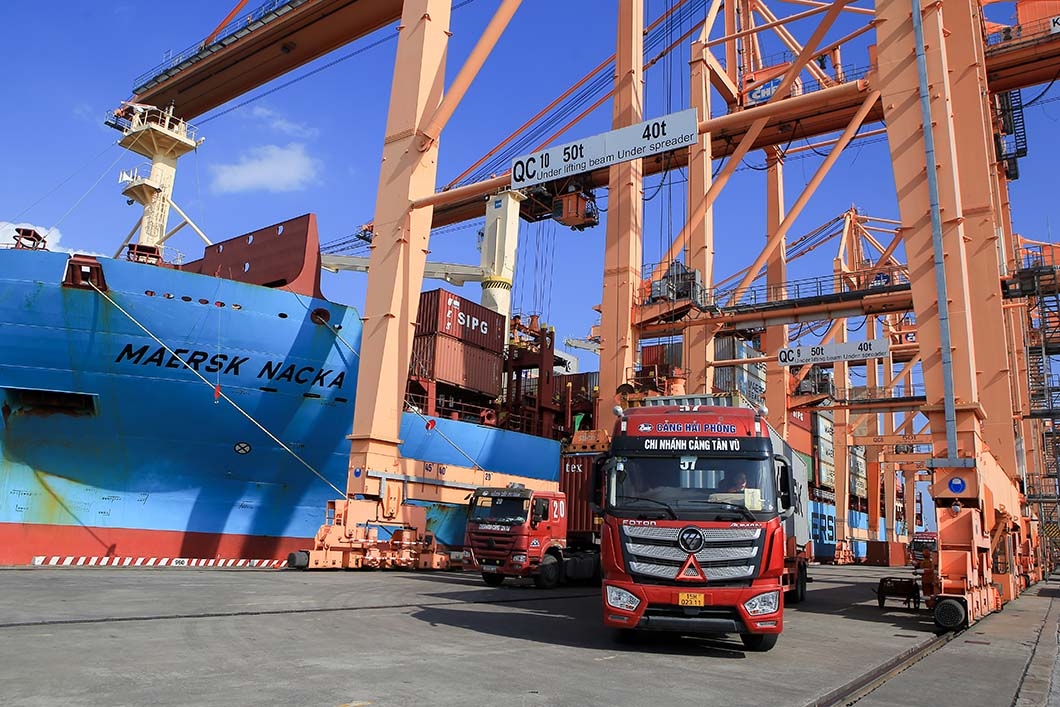
Strategic Vision: Integration and Modernization
Plan 96 identifies the development of logistics services in Hai Phong through integrated "Seaport - Industry - Trade - Services - Urban" development. The city will utilize deep-water seaports, international airports, railways, and economic corridors as pillars to ensure seamless connectivity between international, inter-regional, and domestic logistics. Hai Phong is moving beyond traditional services to prioritize high-value-added, professional, and modern services, focusing on integrated logistics packages, international transshipment, and particularly logistics for cross-border e-commerce. The goal is to gradually form a complete logistics ecosystem closely linked with digital transformation, green transition, and innovation.
Ambitious Quantitative Goals
The city has outlined specific development milestones through two strategic stages to measure implementation effectiveness.
For the 2025 - 2035 period:
- Economy: The goal is for logistics services' value-added contribution to GRDP to reach 10% - 13%, with an annual growth rate maintained at 12% - 15%.
- Market Liquidity: The rate of enterprises outsourcing logistics services is targeted at 70% - 80%.
- Free Trade Zone (FTZ): The city strives for at least 70% of import-export goods through the FTZ to use integrated logistics services.
- Technology & Green: 80% of logistics enterprises should use digital transformation solutions, and at least one pilot model of "Green Logistics – Green Port – Green Warehouse" will be formed.
- Human Resources: 70% of workers are to receive technical professional training, with 30% possessing a university degree or higher.
Vision to 2050: Hai Phong aims to increase logistics' contribution to GRDP to 13% - 15% with a growth rate of 15% - 17%. At that time, 100% of logistics enterprises will apply digital solutions, and 90% of workers will be highly technically trained. The city expects to bring the sector's net emissions to zero, contributing to national goals.
Breakthroughs in Infrastructure and Key Projects
To realize these objectives, Hai Phong focuses on developing synchronous infrastructure. A symbolic project is the construction of the Hai Phong Interdisciplinary Logistics Platform (SmartLog Haiphong) and the Scheme for developing modern international logistics centers linked to seaports and economic corridors. The city will also accelerate investment in the Free Trade Zone (FTZ) linked to seaports and airports to create true international transshipment points.
Specific priorities include:
- Reviewing and amending logistics center planning at key economic locations to international standards.
- Investing in transport systems supporting agricultural supply chains across all modes from road to air.
- Building direct connecting roads between major port areas like Dinh Vu, Lach Huyen, and Nam Do Son and logistics centers, including dedicated lanes for motorcycles and non-motorized vehicles for safety.
- Developing Logistics Parks, smart warehouses, and specialized warehouses for chemicals and industrial goods.
- Forming a strong container shipping fleet capable of reaching intra-Asia and global markets while upgrading cargo aircraft fleets.
Regional and International Connectivity: The Core of Diffusion
Hai Phong identifies itself as the core in regional linkages with Hanoi, Quang Ninh, and Red River Delta provinces. The city will prioritize major economic corridors like the Eastern North-South axis and the Lao Cai - Hanoi - Hai Phong - Quang Ninh corridor. Internationally, Hai Phong proactively expands cooperation with major global logistics centers, particularly connecting with strategic partners like China and Singapore. Through policy dialogue forums and free trade agreements, the city will provide opportunities for local businesses to participate more deeply in global value chains.
Institutional Reform and Human Resource Development
The State will play an enabling role by improving institutions and the investment environment. Hai Phong will implement specific mechanisms to attract multinational corporations to invest in large-scale manufacturing plants and logistics centers. Support will also be provided for businesses to establish overseas representative offices and branches. Regarding human resources, the city will diversify training from primary to postgraduate levels, strengthening domestic-international educational partnerships to meet integration standards.
Smart and Green Logistics: An Inevitable Trend
Digital transformation is considered the "soul" of this plan, including modernizing customs on digital platforms and making procedures transparent to facilitate business. A "Sandbox" mechanism (controlled testing) will be applied for new technological solutions to optimize cargo routes and warehousing. Simultaneously, the city will support businesses in achieving international sustainable growth certifications through emission reduction or carbon credit trading. Regular propaganda on green logistics will be implemented to raise environmental awareness within the business community.
Supply Chain Security and Order and Safety
Hai Phong remains committed to ensuring economic and national security during its development. The City Police are tasked with leading security at key infrastructures like seaports, Inland Container Depots (ICDs), bonded warehouses, and transport routes. The city will resolutely fight smuggling, trade fraud, money laundering, and the abuse of logistics for illegal acts. Cyber security for logistics and port management systems is a top priority to prevent cyberattacks.
Implementation: Clear Person, Clear Task
Plan 96 follows the principle of "clear person, clear task, clear time, clear responsibility, clear product, and clear authority". The Hai Phong City People's Committee has assigned the Department of Industry and Trade as the focal point. Funding will be arranged from the city budget and other legalized socialized sources. Units must report periodically before November 30 each year and conduct a mid-term evaluation in 2030.
With this detailed and long-term roadmap, Hai Phong is confidently entering an acceleration phase to become an international-scale logistics center, contributing to the country's sustainable prosperity in the digital and green era.