
According to the United Nations’ Environment Program (UNEP), green economy is a low carbon, natural resource and energy efficient and socially inclusive[1]. In the green economy, inhabitants’ jobs and incomes are driven by economic activities in both public and private sectors, the living environment is protected; biodiversity and ecological environment are guaranteed. In other words, a green economy brings positive outputs and outcomes in human living quality improvement and social equality as well as significantly diminishes environmental risks and ecosystem sacrifices[2], in order to serve human eco-social development.

Construction of a green and inclusive economy.Photo: https://www.unep.org/pt-br/node/6538
In the present, many ways have been applied to green economy approach. According to Karl Burkart, a green economy is grounded on the factors as following: i)renewable energy, ii)green buildings, iii)sustainable transportation; iv)water management, v)land management, vi)waste management[3]. According to International Chamber of Commerce Commission (ICC), a green economy guarantees an economic growth aligned with environment protection and social progress[4]. At the Summit on Sustainable Development organized by the UN at Rio de Janiero (Brazil), green economy is tied with green manufacturing activities, green products, green consumption, green living style, etc.[5]
In green economy, economy plays a key role in tackle global challenges, closely and effectively cooperation between manufacturing – business sectors and public management in transforming process to green economy, in which favorable conditions have occurred to facilitate opening and competitive economy with investment, finance, awareness of stakeholders and levels, effective usage of natural resources, human source, education and skills training, operation management and partnership, integration policies and decisions guaranteed to implementation.
Green economy is built on the ground of an innovative system of growing and responsible economic activities, social welfare enhancement, protected, reserved, and nurtured natural environment. Many countries across the world have gradually moved their economies to green ones through various ways. For instance, Curitiba city (at Parana State of Brazil) deployed innovative systems to serve its sustainable urban plan construction and to handle pollution challenges caused by increasing population during previous decades. Within an area of above 430 km2, an increasing number of 3 million urban inhabitants and forecasted to continuously grow, Curitiba has been one of the most crowded cities in Brazil. To cope with urban transport challenge at the city, the rapid bus system model (BRT) was applied by Curitiba and was considered a successful model not only in Brazil and Latin America, but also in many other countries at nation while. With 06 corridors, 359 bus stations (including 30 terminal stations), tickets’ fixed cost applied in all buses transporting network, Curitiba gained achievement in encouraging residents to use BRT. In fact, at Curitiba, 75% of locals travels daily by the BRT, bus stations were convenient for passengers, air quality was significantly improved (when a majority of locals chose public vehicles for travel), etc.
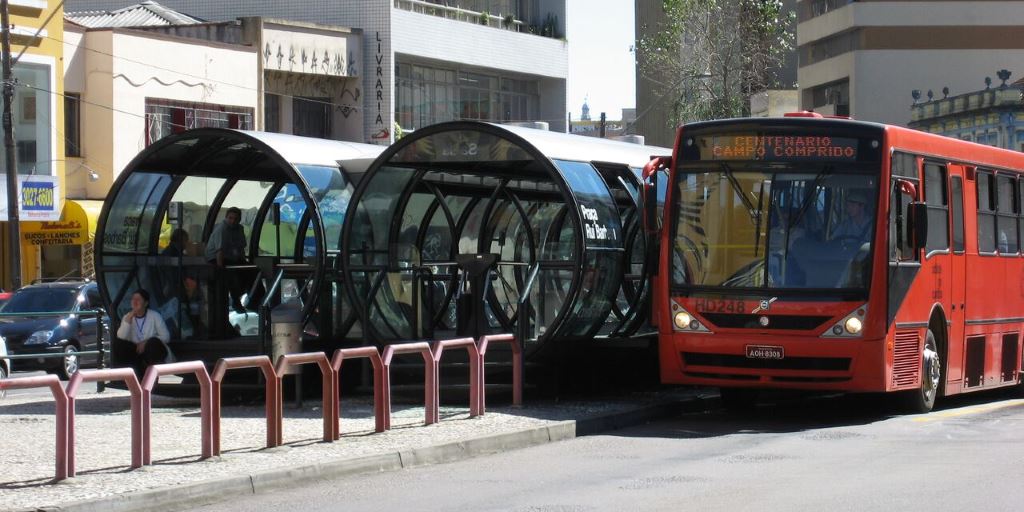
A bus station at Curitiba.Source: https://development.asia/case-study/what-worlds-first-bus-rapid-transit-system-can-teach-us
In Europe, certain countries have applied CO2 tax to cut down greenhouse gas emission. For instance, Finland was the first country in Europe and in the world suggesting CO2 taxation in 1990. Following Finland, 18 other countries in Europe have deployed CO2 tax, such as: 01 ton of CO2 released to the atmosphere has had to pay tax of 0.07Euro (Poland), 45 Euro (France), 62 Euro (Finland), 116.33 Euro (Sweden). In present, all countries in the EU (plus Norway, Liechtenstein, Iceland) are part of the EU’s gas emission trading system, except Switzerland (owning proper gas emission trading system since 2020) and the UK (left the EU already and deploying its own greenhouse gas emission trading system since 2021)[6]. European governments have also considered to end fossil fuel subsidies in Europe under the revision of the Energy Taxation Directive (ETD) as a part of taxation adjustment aligned with the EU’s environmental objectives[7]. Contributing to CO2-reducing measures, countries including the Netherlands, Germany, Belgium, Sweden, Luxembourg, Denmark, Italia, Bulgaria signed in a common declaration on November 07th 2019 requesting the EU to end tax exemptions to aviation. In 2018, Sweden promulgated aviation tax; Germany has also imposed aviation tax for environment protection[8]. Besides, European governments have considered tax reduction for low income households, social security contribution reduction for small and medium sized companies, tax increase applied for corporate profits and personal wealth[9].
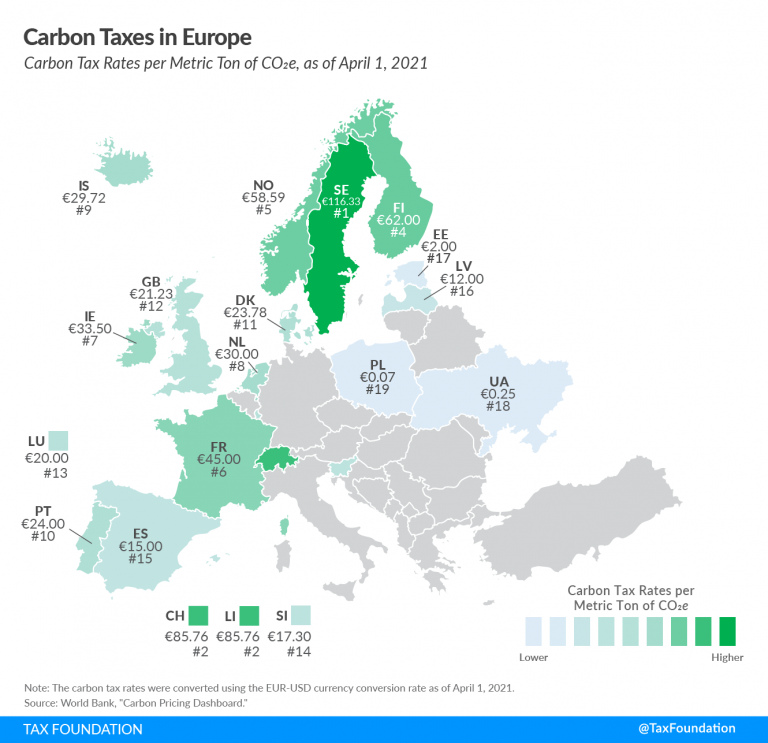
CO2 taxation at the Europe (by each ton of CO2 released to the atmosphere) on April 01st 2021.Source: https://taxfoundation.org/carbon-taxes-in-europe-2021/
Operation of the green economy has not only resulted in strong measures of taxation to fossil fuel-usesectors, smart transportation, but also occurred in handling issues related to urban waste and waste water. For example, Sweden has been leading in landfill waste disposal and recycles; Denmark, Finland, the Netherland and Singapore have enriched experiences in wastewater treatment[10].
Green economy is a momentum to countries moving toward national targets of sustainable development. Role of governments in building and promulgating policies facilitating opening and competitive economic development, effective exploration and usage of energy sources, role of renewable energies and tech science application in manufacturing, businesses, and daily life, enhancement of communities’ awareness and attitude to manufacturing, businesses, consumption, etc.
In the common trend of green economic construction, environment protection and towards sustainable development, “green economy” has gradually appeared more in Vietnam. Being a coastal nation suffering impacts of climate change, timely response to climate change has been one of important requirements to Vietnam’s sustainable development. Plus, being a developing country, cuting down greenhouse gas emission has been an uneasy mission, because many economic sectors, manufacturing, eco-social infrastructure, and normal daily life have been attached with conventional energies (gasoline, gas, coal, etc.). Harmonizing national development targets with national attempts contributing to CO2 reduction has been critical and beneficial for the country’s economy in the long run. Being aware of the aforementioned affairs, in previous years, Vietnam promulgated many policies serving the green economy.Direction on“rapid and sustainable development... harmonized development between depth and expansion, focusing on development in depth; knowledge development, green economy” was noted in the Resolution of the 12th National Party Congress. Strategic orientation for sustainable development in Vietnam (issued atDecision no. 153/2004/QĐ-TTg) was identified as one of privileged activities in the economic sector, which is to build green economy. By 2012, Vietnam's sustainable development strategy for a period of 2011-2020. (attached at Decision no. 432/QĐ-TTg) clarified that sustainable development has been a throughout demand in national development process, and that construction and implementation of green growth strategy have guaranteed economic development towards low greenhouse gas emission. Targets have been restructuring and accomplishing economic mechanisms towards greening current sectors, encouraging development of economic sectors effectively using energy and natural sources with set-up high added value. At the same time, targets have been set on increasing coastal mangrove rates, watershed protection forest, green growth action plans of branches, regions and localities.
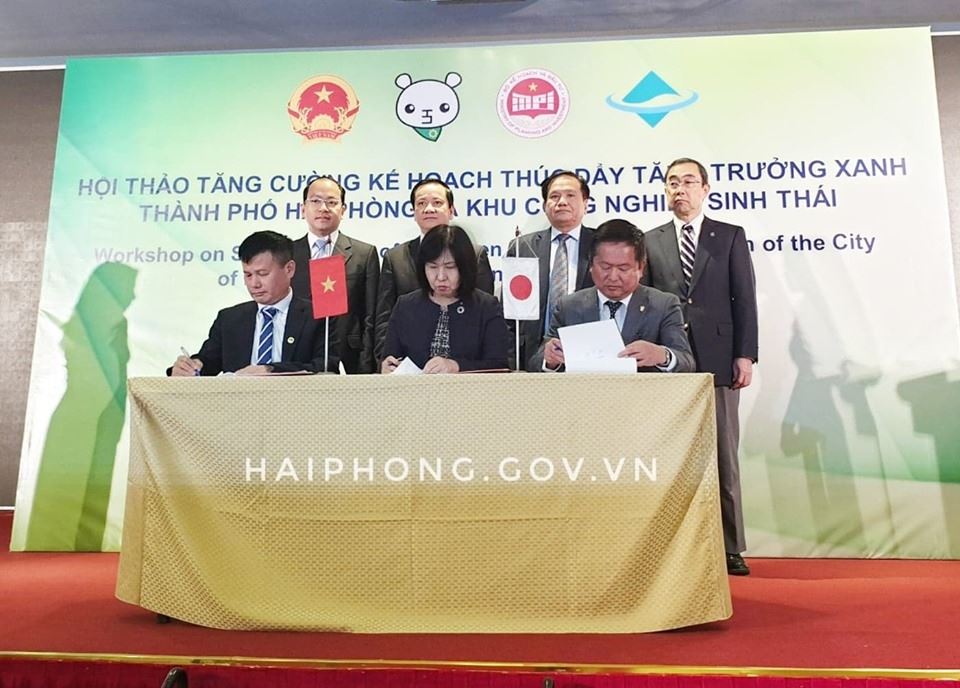
Workshop on Green Growth Plan of Hai Phong City, Eco Industrial Park, at Hai Phong on December 11th 2019. Photo source: https://haiphong.gov.vn/tin-tuc-su-kien/Hoi-thao-tang-cuong-Ke-hoach-thuc-day-tang-truong-xanh-thanh-pho-Hai-Phong-va-KCN-sinh-thai-39308.html
At Hai Phong, implementing the State’s orientation and policies, the city authority built and issued plans to serve industrial development, green growth targets, climate change’s impacts reduction to eco-social development and local livelihoods. On July 03rd2014, Hai Phong People’s Committee launched Decision no. 1463/QĐ-UBND issued an Action Plan for implementing National green growth strategy in a period of 2014-2020, and one of tasks noted at the Decision is to research green models such as green port, green urban, green industry, green agriculture, green environment, etc. Besides measures on tech innovation, research, construction and accomplishment supportive policies to implementation of plans, urban planning innovation, land use, planning adjustment review of manufacturing sectors, etc., measure of international cooperation enhancement, taking advantage of support of foreign partners, domestic and foreign international organizations in the implementation of the green growth strategy that has been promoted in recent years. Pilot projects with foreign partners and organizations have been implemented in the city, such as building an eco-industrial park pilot model, researching compost production from waste, raising awareness of coastal communities about climate change and improving climate change mitigation capacity, etc. In addition, small-scale pilot projects on renewable energy production and operation (solar power, etc.) have been researched and deployed in the city with a hope of opening new directions in mining and using energy effectively, contributing to building a friendly-environment economy, and serving sustainable development./.[1]https://www.unep.org/regions/asia-and-pacific/regional-initiatives/supporting-resource-efficiency/green-economy
[2]UNEP, 2011, “Towards a green economy: Paths to poverty elimination and sustainable development”, accessedhttp://www.unep.org/greeneconomyon September 02, 2021.
[3]https://www.sociologygroup.com/green-economy/
[4]https://iccwbo.org/content/uploads/sites/3/2012/08/Green-Economy-Roadmap-a-guide-for-business_-policy-makers-and-society.pdf
[5]https://www.unep.org/resources/report/rio20-outcome-document-future-we-want
[6]https://taxfoundation.org/carbon-taxes-in-europe-2021/
[7]https://ieep.eu/news/green-economy/fair-and-green-a-new-european-grand-bargain-on-tax-is-possible
[8]https://nhandan.vn/tin-tuc-the-gioi/chin-nuoc-eu-keu-goi-ap-thue-hang-khong-nham-giam-phat-thai-376310/
[9]https://ieep.eu/news/green-economy/fair-and-green-a-new-european-grand-bargain-on-tax-is-possible
[10]https://citygreen.com/the-top-10-greenest-countries-in-the-world/