
The 2025 edition of the Container Port Performance Index (CPPI), issued by World Bank, marks a critical milestone in assessing the efficiency of global maritime gateways during a period of sustained volatility. Based on empirical vessel time in port, the index reveals that while ports are essential enablers of trade, they are increasingly sensitive to geopolitical shocks, climate-related disruptions, and the "burst congestion" characteristic of modern supply chains.
Global Trends in Vessel Time: A Nuanced Deterioration
In 2025, the global average CPPI recorded a slight deterioration compared to the 2024 benchmark, indicating an overall increase in vessel time in port. This aggregate movement was not uniform but rather a result of diverging regional and income-based developments.
- Income Group Dynamics: High-income (HI) and upper-middle-income (UMI) economies generally maintained shorter turnaround times due to superior infrastructure, advanced digital systems, and better stakeholder coordination. Notably, ports in UMI economies, particularly in East and South Asia, continued to outperform many HI peers, benefiting from export-oriented trade structures and intense inter-port competition.
- Regional Shifts: Sub-Saharan African ports recorded structurally longer vessel times, often linked to import-dominated trade and capacity constraints. Meanwhile, the Middle East experienced a performance decline following schedule disruptions from the Red Sea crisis, highlighting the vulnerability of even highly capital-intensive ports to geopolitical shocks.
The Nexus of Port Performance and Supply Chain Stress
The 2025 CPPI highlights a significant mutual relationship between port efficiency and global supply chain stress. This causality runs in both directions:
- Stress Impacting Ports: When supply chain volatility surges, vessels arrive out of sequence or in clusters, creating "burst congestion". These short but intense episodes rapidly overwhelm berth and yard capacity, even in top-performing ports.
- Ports Transmitting Stress: Conversely, inefficient ports act as stress transmitters. Every additional hour a ship spends idle at anchor or berth effectively shrinks global shipping capacity, contributing to higher freight rates and propagating delays to subsequent ports along service strings.
The data shows that ports with high baseline efficiency act as stabilizers, damping shocks and recovering faster from disruptions.
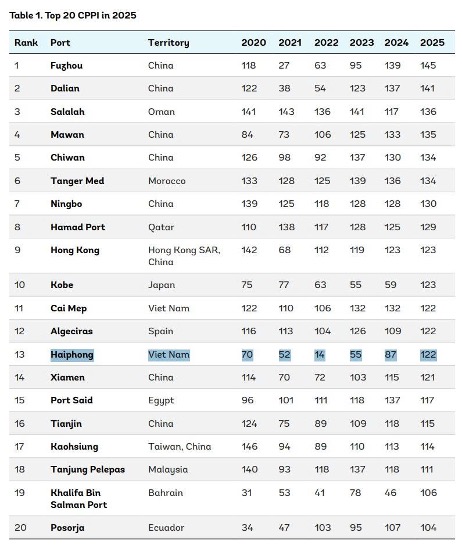
(Top 20 CPPI in 2025. Source: World Bank)
Analysis of the Hai Phong Case: A Trajectory of Improvement
Amidst global fluctuations, Hai Phong (Viet Nam) has emerged as a standout performer in the 2025 index. The port’s trajectory over the past six years reflects a resilient recovery and significant structural improvement:
- Global Ranking: In 2025, Hai Phong secured the 13th position globally with a CPPI score of 122. It stands as one of the two top-performing Vietnamese ports, alongside Cai Mep (ranked 11th).
- Improvement Milestone: Hai Phong is ranked 6th globally for its improvement between 2020 and 2025. Its score rose from 70 in 2020 to 122 in 2025, a total improvement of 52 points.
Based on analyses of leading ports and those with the most significant improvements in the literature, key factors contributing to Hai Phong's ranking in the world's top 20 include:
- Time Absorption: Leading ports like Hai Phong achieve high performance by minimizing the time ships spend waiting outside the channel or idle at berths. Maintaining short and predictable vessel turnaround times demonstrates a good combination of maritime accessibility, berth availability, and handling productivity.
- Resilience: Hai Phong is recognized as one of the ports with the most significant performance improvements in the 2020–2025 period (ranked 6th globally in terms of improvement). The ability to maintain operational discipline even amidst volatile supply chains allows the port to recover quickly from shocks.
- Advantages from an export-oriented trade structure: Ports in East Asia, such as Hai Phong, often score highly due to their export-oriented model. This characteristic allows containers to be pre-sorted in the yard for loading onto ships, thereby increasing crane productivity and reducing ship waiting times.
- Investment and competition: Hai Phong is among the upper-middle-income economies, which have experienced faster growth thanks to continuous investment and intense competition among ports in the region.
- Digitalization application: Sources emphasize that the use of digital tools such as Port Operations Systems (TOS), Port Community Systems (PCS), and data sharing between shipping lines and ports helps shift from reactive to proactive operations, thereby improving predictability and efficiency.
- Effective coordination and governance: High performance is often coupled with a synchronization of interests and roles between the port, terminal operators, and service providers. A stable legal framework and good coordination help minimize bottlenecks in the operational process.
Structural Lessons for the Future
The 2025 CPPI evidence suggests that top performers like Hai Phong succeed by focusing on operational discipline and digitalization. By integrating digital tools like Predictive Berthing and Dynamic Yard Allocation, ports can shift from reactive to anticipatory operations, which is essential for managing the volatile arrival patterns of 2025. As global trade enters an era of frequent external shocks, the ability of a port to minimize non-productive time is no longer just a local efficiency goal, but a prerequisite for global supply chain resilience.