
Within the framework of the opening session of the 33rd Diplomatic Conference held on the morning of August 1, 2026, the presentation by the Minister of Finance attracted special attention as it outlined a roadmap for comprehensive international financial integration tied to the country's sustainable economic growth goals for the 2026–2030 period. Affirming the pioneering role of the financial sector throughout 40 years of Renovation, the Minister proposed four strategic orientations to maximize the mobilization of external resources in service of the aspiration to build a strong and prosperous Vietnam.
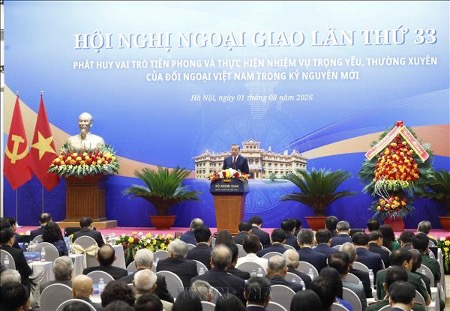
(The General Secretary and President speaking at the Conference - Photo: VNA)
Pioneering Role and Brilliant Achievements After 40 Years of Renovation
Looking back on the journey of more than 40 years of integration and Renovation, the Minister of Finance affirmed that the financial sector has always played a pioneering role, from building the first legal framework to attract foreign investment in 1987 to normalizing relations with international financial institutions in 1993 and joining ASEAN in 1995. To date, Vietnam has become an active member of many multilateral financial cooperation mechanisms, signing 17 Free Trade Agreements (FTAs), 81 Avoidance of Double Taxation Agreements, and 60 Investment Encouragement and Protection Agreements.
These strategic steps have contributed to maintaining an average economic growth rate of 6%–7% over the past three decades. Notably, the national finance is increasingly strong, with public debt by 2026 projected at only 36% of GDP, significantly lower than the allowed ceiling, creating substantial room for fiscal policy management. The financial market has also developed extensively, with the stock market size reaching 62.3% of GDP and the corporate bond market reaching 22.1% of GDP. The prestige of Vietnam's finance has been markedly enhanced as international organizations like FTSE upgraded the market and improved national credit ratings, bringing Vietnam closer to investment-grade status.
New Context and Breakthrough Integration Mindset
In the face of rapid fluctuations in global strategic competition, supply chain shifts, the AI revolution, and the green transition, the Minister emphasized that international integration must be approached with a new mindset. Integration is not just about expanding markets but must directly serve the goals of improving productivity, growth quality, and the resilience of the economy. The consistent spirit is: "External resources are important and a breakthrough, but internal resources are decisive and central," based on maintaining independence and strategic autonomy.
Four Strategic Orientations for the 2026–2030 Period
To realize the goal of double-digit economic growth, the Minister of Finance thoroughly mastered four major orientations:
- First, improving the efficiency of mobilizing and using international resources: With the national financial plan for the 2025–2030 period having a total budget expenditure of approximately 21.2 quadrillion VND, the financial sector will closely combine state resources with international and private sector resources. The Ministry of Finance will expand cooperation with multilateral financial institutions to diversify mobilization channels for ODA and preferential loans, focusing on strategic infrastructure, digital transformation, and science and technology projects.
- Second, developing a modern, transparent, and safe capital market: The financial sector is committed to perfecting the legal framework, improving corporate governance quality, and market discipline. The central goal is to effectively leverage the upgrade in the emerging market, thereby strengthening the confidence of the international investment community and reducing international capital mobilization costs to serve rapid development.
- Third, fundamentally innovating the mindset for attracting Foreign Direct Investment (FDI): Shifting the focus from "capital supplementation" to "proactively selecting strategic partners" with high technological levels and modern management capabilities. The financial sector will implement investment support mechanisms such as the National Investment Support Fund (Resolution No. 182) to attract multinational corporations in the fields of semiconductors and source technology, while promoting knowledge transfer and the development of the domestic supplier ecosystem.
- Fourth, promoting digital transformation associated with integration and international standards: The financial sector identifies international governance of science and technology as key to promoting digital transformation. Vietnam will proactively participate in building standards for digital finance, fintech, and big data to enhance the compatibility of the national financial system with the global financial system.
Close Coordination for Common Goals
Concluding the presentation, the Minister affirmed that the financial sector will coordinate closely with the diplomatic sector and relevant ministries and branches to comprehensively innovate financial foreign affairs. This cooperation aims to create collective strength, turning integration into a driving force for institutional reform and raising the national position.
With a new mindset and vision, financial foreign affairs work commits to making practical contributions to building a favorable investment environment, realizing the aspiration of making Vietnam a developed, high-income country by 2045. The consensus of foreign affairs and financial agencies is the "lever" for Vietnam's ship to move steadily forward into a new era of development.