
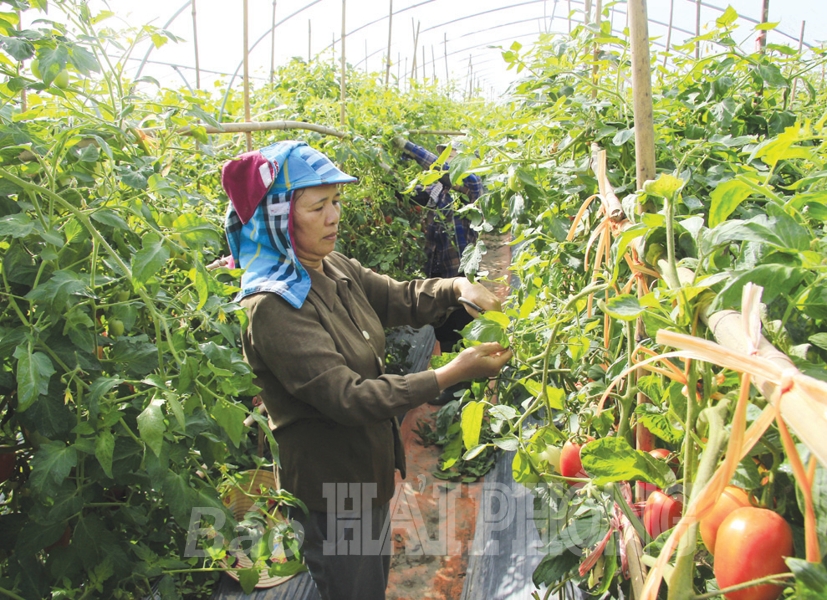
Mechanisms and policies in encouraging the development of agricultural production will create more favorable conditions for farmers. Photo: HOANG PHUOC
(Project No. 10/DA-UBND dated November 12, 2021 of the City People's Committee submitted to the 4th session of the 16th City People’s Council)
- THE NECESSITY OF PROJECT
Over the past time, the City has implemented a number of programs, projects, mechanisms and policies to support the development of agriculture and fishery such as: planning high-tech agricultural zones and regions; promulgating mechanisms and policies in encouraging the development of agricultural and aquacultural production, rural economy to raise people's incomes by 2020; supporting the development of vegetable and fruit production in the city, Through which the City’s agriculture production has enjoyed quite comprehensive development. The production value of agriculture, forestry and fishery in 2020 increased by 1.5% to reach 15,334 billion VND, 1.06 times higher than that in 2016 (14,184 billion VND). The economic structure has shifted in the right direction, increasing the proportion of fishery and reducing the proportion of agriculture in total production value; agricultural production infrastructure has been built and upgraded step by step to ensure production in modern direction. Productivity of labor, crops and livestock increased significantly; production protection was well conducted; People's income has constantly been improved, which made an important contribution to building new rural areas.
However, current agricultural production still faces many difficulties and limitations. The main crop remains rice plant, accounting for 78.75% of the cultivated areas with lower yield, value and income than other crops; land has been accumulated but still fragmented (about 10-20 households/ha); the restructuring of crops and livestock on rice land was still slow; the situation of no-cultivation and abandonment of uncultivated fields was being increased; The application of mechanization and high technology has not been synchronized in production. The concentrated areas were still small of 1,863ha, accounting for 6.21% of arable land; hi-tech areas merely reach 3.71% of the plan (215 ha/5,800 ha). Small-scale livestock production was potentially causing many risks to biosecurity; epidemics have occurred and caused damage to production, while livestock environment was polluted.
The areas of intensive and semi-intensive fishery remain small, accounting for 12.90% of the total fishery area; marine fishery faces numerous shortcomings in terms of natural environment and farming techniques. Although fishing has been mechanized with highly productiveoffshore fishing vessels fleet for consumption and export., the fishing equipment was not synchronized whereas the fishing structure was not suitable given the reserve of aquatic resources; the fishing intensity was huge while the value was not high.
Agricultural land area was gradually narrowed (over 2,300ha/year); the shift of labor in agriculture to other fields has increased rapidly, causing shortage of labor in agriculture; Investment resources for agriculture and fishery development were not appropriate.
Currently, there are many new guidelines, policies and regulations in agriculture and fishery. Resolution No.45-NQ/TW dated January 24, 2019 of the Politburo on the construction and development of Hai Phong City to 2030, with a vision to 2045 identified: "Strengthen the restructuring of agriculture sector in association with the construction of new countryside in line with the process of industrialization and urbanization". Conclusion No.54-KL/TW dated August 7, 2019 of the Politburo on continuing to implement the Resolution of the 7th Central Committee (the 10th session) on agriculture, farmers and rural areas determined: To promote the policy of land accumulation and concentration for the development of large-scale agricultural production with high competition; well perform the conversion of inefficient rice land to grow other more effective crops and livestock. Law on Planning, Law on Fisheries, Law on Livestock, Law on Cultivation, Decree No. 57/2018/ND-CP have came into force with many regulations in agriculture changed.
Many policies to encourage the development of agriculture and fishery of the Government, the Prime Minister and the City have expired; a number of policies have not specified support levels and not met practical requirements of the City in the coming period as well as unsynchronized; there is a lack of policy on: loans to support the production infrastructure construction and upgrade; tracing agricultural products’ origin.
In addition, the Government had issued Decree No. 57/2018/ND-CP dated April 17, 2018 on mechanisms and policies on encouraging businesses to invest in agriculture and rural areas (replacing Decree 210/ 2013/ND-CP), in which Clause 1, Article 19 stipulated that the City People's Council had the duty to issue a Resolution with two contents, specifically: (i) Credit support policy as prescribed in Clause 1, Article 8 of Decree No.57/2018/ND-CP dated April 17, 2018 of the Government; (ii) Capital level from the city budget to ensure business support as specified in Article 14 of Decree No. 57/2018/ND-CP dated April 17, 2018 of the Government.
In order to speed up the restructuring of the city agricultural industry towards modernity, concentrated commodity production, large scale, high technology to create products with high competitiveness and added value; overcome the situation of fragmented land, uncultivated fields and small-scale production; in line with the urbanization process of the City. Building resolutions of the City People's Council stipulating mechanisms and policies on encouraging the development of concentrated production of agriculture and fishery in Hai Phong City is necessary, appropriate and within the competence of the City People's Council.
- DIRECTION OF DEVELOPING AGRICULTURAL AND AQUACULTURAL PRODUCTION TO 2025
- To step up the restructuring of the agricultural sector in association with the construction of new countryside and the process of industrialization, modernization, urbanization of agriculture and rural areas to improve the income and living standards of the city's farmers; guidelines and instructions for the construction and development of Hai Phong City to 2030, with a vision towards 2045, the strategy for developing Vietnam's marine economy and that for agriculture, farmers and rural areas; take advantages of natural conditions, potentials and strengths of the City to link the northern key economic region, the Red River Delta, the Northern Coast region and to deepen international integration.
- To develop the concentrated and large-scale commodity production of agriculture and fishery, focusing on production using technical advances and synchronous high technology to create new products of large quantity, high quality, competitiveness and added value, meeting the food needs of the city, the country and for the export; ensure food safety and hygiene, protect environment; raise the income of rural people and the quality of indicators for building new exemplary countryside, restructure the city's agricultural sector.
- To increase all economic sectors’ participation, create favorable conditions for experienced and capable enterprises, cooperatives, cooperative groups and individuals to apply technical and high-tech advances in large-scale agricultural and fishery production, overcoming the problem of uncultivated fields causing waste of land; focus on consolidating and developing forms of concentrated production, farms, disease safety, food safety, and agricultural products’s origin tracing.
- Value of agricultural and aquacultural production: GRDP growth in agriculture, forestry and fishery reached 1.1%/year with production value growth reaching 0.93%/year. The structure of production value of agriculture - forestry - fishery is 55.90% - 0.20% - 43.90% respectively.
III. PURPOSES, VIEWPOINTS OF THE PROJECT
- Purposes:
To formulate and organize the implementation of policies on encouraging the development of concentrated, large-scale commodity production of agriculture and fishery using modern technology, ensuring the practicality and suitability to the city's potentials and strengths; produce large commodity products to meet the food needs of the city, the country and for the export; ensure food safety and hygiene, protect environment; raise the income of rural people and the quality of indicators for building new exemplary countryside, and restructure the city's agricultural sector.
To concretize policies on supporting businesses in agriculture and rural areas according to Decree No. 57/2018/ND-CP dated April 17, 2018 of the Government to encourage and attract businesses to invest in agriculture and rural areas in Hai Phong City.
- Viewpoints
The policy on development of agricultural and fishery production must be consistent with the policy on accelerating the restructuring of agricultural sector in association with the construction of new exemplary countryside and the process of industrialization, urbanization of the City as well as the current laws.
The policy must be appropriate helping encourage organizations and individuals to apply modern technologies to concentrated and large-scale commodity production of agriculture and fishery to increase farmers' incomes and agricultural land-use values; overcome the situation of uncultivated fields causing waste of land.
The implementation of the policy must ensure publicity and transparency; support organizations and individuals directly engaged in agricultural and aquacultural production; focus on consolidating and developing models of concentrated production, farms; guarantee disease safety, food safety, and agricultural products’ origin tracibility.
- SUBJECTS, SCOPES OF THE POLICY
- Scopes
Regulating policy on encouraging the development of concentrated agricultural and aquacultural production in Hai Phong City.
- Subjects
2.1. Organizations and individuals engaged in agricultural and aquacultural production; processing agricultural and aquatic products; slaughtering ; fishery exploitation in Hai Phong City is specified in each policy of Resolution.
2.2. State agencies and units; organizations and individuals involved in the implementation of Resolution.
- Implementation principles
3.1. The policy only supports organizations and individuals that fully meet production and business conditions as prescribed by laws as well as those of each specific policy. Heads of agencies, officials in charge of support appraisal must take responsibility before legal regulations for appraisal contents according to their assigned responsibilities and tasks.
3.2. If there are many relevant policies at the same time or new policies of the State are issued with the same support contents, the beneficiaries can only select and apply the most beneficial support policy.
3.3. Costs for directing and implementing the Resolution (including propaganda, examination, supervision, summation and evaluation) shall comply with current regulations.
- OBJECTIVES, CONTENTS OF THE POLICY; SOLUTIONS TO IMPLEMENTING THE POLICY IN RECOMMENDATIONS FOR BUILDING RESOLUTION
- Policy 1: To support the development of concentrated and large-scale commodity production of agriculture and aqua culture
1.1. Policy goals:
- a) To create favorable conditions for organizations and individuals to access sufficient capitals for construction and upgrade of modern infrastructure, equipment and machinery; agricultural and fishing equipment fulfil the standards stipulated by current regulations; apply modern technology to large-scale concentrated production, create commodity with high added value and competitiveness, meeting the consumption needs of the City, the domestic and export markets.
- b) To encourage the development of concentrated, large-scale and modern commodity production; step by step overcome the situation of small-scale, fragmented production, abandoned land without cultivation; accelerate the restructuring of agricultural sector in line with the process of industrialization, modernization and urban space expansion of the City.
1.2. Policy contents:
Cooperatives, cooperative groups, households and individuals having plan for investment in agricultural production, aquaculture, livestock and poultry slaughter, and fishing (referred to as the plan) are approved by the District-level People's Committee to receive 100% annual support on interest rate of bank loans from the city budget to implement the plan.
The abovementioned maximum interest rate support is applied when the loan does not exceed 70% of the total investment capital of the plan, but not more than: 600 million VND/ha of cultivation land, 700 million VND/farm for livestock, 5,000 million VND/slaughterhouse, 1,000 million VND/ha for aquaculture, 1,200 million VND/fishing vessel.
The maximum support time is 3 years (36 months) from the time of loan disbursement. Investment items eligible for loan interest support include:
- For crop production: To invest in building new net houses, greenhouses, automatic irrigation systems (machines and equipment), cold storages to preserve agricultural products; buy machines for plowing, planting, tending and protecting plants, harvesting and drying agricultural products.
- For livestock farms: To build new farms or expand livestock production scale or upgrade infrastructure in terms of barns, electricity, water, cooling system, waste treatment, product storage warehouse; buy specialized machines and equipment for animal husbandry.
- For slaughtering: To build new facilities or upgrade infrastructure for electricity, water, factories, cold storage for product preservation (freezing), waste treatment; buy slaughter lines and equipment.
- For aquaculture: To build new infrastructure of ponds, farming tanks, canvas houses, water supply, drainage, environmental treatment, cold storage warehouse for product preservation; install cage, machine, aeration fan equipment.
- For fishing vessels: To invest in new fishing tackles; machinery and equipment for aquaculture preservation and fishery, ice production, seawater filtration for fresh water; freezing tunnels (chambers) with refrigeration system, product storage tanks (cellars); fishing boat conversion.
1.3. Conditions to get supports:
- a) To have a plan approved by the District-level People's Committee.
- b) Production lines, machines and equipment must be new ones with quality conforming to announced standards as prescribed by Law on product and goods quality.
- c) Minimum scale: 01 ha for cultivation, aquaculture ponds; 01 aquaculture raft; 200 pigs, 10,000 poultry for livestock farms; the slaughtering capacity per day and night reaches 100 pigs or 1,500 poultry or 50 buffaloes/cows for cattle and poultry slaughter; fishing vessel with the maximum length of 15 m and above.
- d) There is a commitment to strictly follow the approved plan; allocate sufficient capital and necessary conditions to implement the plan.
1.4. Solutions to implement the policy:
- a) Support method: The city budget shall support organizations and individuals with loan interest rates for loans provided by banks (annual support).
- b) Dossier for support
- Request form for support certified by the Commune-level People's Committee.
- Decision on approving the plan signed by the District-level People's Committee.
- Loan contract with banks to implement the plan.
- c) Procedure order
- Organizations and individuals submit request form and production plans applying GAP, organic agriculture standards, and disease-free livestock to the District-level People's Committees.
- Within 10 (ten) working days, the District-level People's Committee shall appraise and approve the proposed support plan of organizations and individuals; send the dossier to Department of Agriculture and Rural Development.
- Within 10 (ten) working days, Department of Agriculture and Rural Development summarizes the plan and works with Department of Finance on the support budget. Department of Finance shall take responsibility for proposing to the City People's Committee to allocate budgets for implementation.
- Basing on the decision on budget allocation of the City People's Committee, Department of Agriculture and Rural Development manages and provides support according to regulations.
- Policy 2: To support certification for application of good and organic agricultural production practices, disease-free livestock and agricultural products’ origin tracibility
2.1. Policy goals:
- a) To encourage organizations and individuals to apply the Good Agricultural Practices (GAP) process, organic farming standards, and disease-free livestock to produce safe products, contributing to improving the quality and added value of Hai Phong agricultural products, meeting the food needs of the city's people.
- b) To encourage organizations and individuals to trace the origin of agricultural and aquatic products by QR Code, contributing to improving competitiveness and transparency of product information; encourage consumers to use products of clear origin, and well manage products and goods.
2.2. Policy contents:
Enterprises, cooperatives, cooperative groups, households and individuals producing and trading agricultural and aquatic products (bases) are supported by the city budget as follows:
- a) 100% one-time support of the cost of assessment and certification to meet the application of good agricultural production practices (GAP), organic agriculture standards, and disease-free livestock, but not more than 45 million VND/unit.
- b) Annual support of 300 VND for each stamp of origin-check using QR Code (QR) attached to an agricultural and aquatic product unit. The support time does not exceed 3 years (36 months); the number of stamps supported is suitable to the scale of production and business; the support level does not exceed 30 million VND/unit/year.
2.3. Conditions to get supports:
- a) To have a production plan applied GAP, organic agriculture standards, and disease-free livestock approved by the District-level People's Committee.
- b) Have been granted certificate of production according to GAP standards, organic agriculture standards, and disease-free livestock as prescribed; QR code stamps to check the origin of agricultural products have been used and activated.
2.4. Solutions to implement the policy:
- a) Support method: The city budget provides post-investment financial support to organizations and individuals on the basis of certificate of GAP, organic products, disease-free livestock, and origin-tracibility.
- b) Dossier for supports:
- Request Form for support.
- The production plan applying GAP, organic agriculture and disease-free livestock standards approved by the District-level People's Committee.
- Contracts, invoices for the assessment costs, GAP certification, organic agriculture standards, and disease-free livestock. Contracts, printing invoices of origin-check stamps (or packages, goods labels printed with origin-check stamps).
- Notarized copy of certificate of GAP, organic agriculture, and disease-free livestock standards; list (image) of QR codes used.
- c) Procedure order:
- Organizations and individuals submit request form and production plan applying GAP, organic agriculture, and disease-free livestock standards to the District-level People's Committees.
- The District-level People's Committees appraise and approve the plan of organizations and individuals; send dossier to Department of Agriculture and Rural Development.
- Department of Agriculture and Rural Development summarizes the plan and works with Department of Finance on the support budget. Department of Finance shall take responsibility for proposing to the City People's Committee to allocate budgets for implementation.
- Basing on the decision on budget allocation of the City People's Committee, Department of Agriculture and Rural Development manages and provides support according to regulations.
- Policy 3: To regulate credit policy to support enterprises investment in agriculture and rural areas according to Article 8 of Decree No. 57/2018/ND-CP
3.1. Policy goals: To partly support commercial loan interest rates for enterprises whose projects are invested in agriculture and rural areas in Hai Phong City, after completing the project.
3.2. Main contents of the policy: Enterprises established, registered and operated under the Law on Enterprises and had investment projects specified in Clauses 3, 4 and 5, Article 3 of Decree No.57/2018/ND-CP dated April 17, 2018 of the Government will be supported by the city budget for interest rate of commercial loans after completing the project as follows:
- a) Support level: Equal to the difference between the interest rate of commercial loan and the credit interest rate of state investment calculated on the actual debt at the time requesting for support.
- b) The interest rate of commercial loan is the commercial bank's lending interest rate specified in loan contract between commercial bank and the enterprise implementing project.
- c) The interest rate of investment credit announced by the State for each period are in accordance with the Government's regulations on state investment credit.
- D) Support time for interest rate is from the date of starting disbursement under the credit contract with the commercial bank, according to the provisions of Point b, Clause 1, Article 8 of Decree No. 57/2018/ND-CP, specifically:
- Up to 8 years for agricultural projects with special investment incentives; up to 6 years for agricultural projects with investment incentives; up to 5 years for agricultural projects encouraged investment.
- If the project is of newly established small and medium-sized agricultural enterprises, the support time for interest rate is 8 years.
- Projects in which enterprises participate in value chain are entitled to interest rate support according to the production cycle of products.
đ) The loan limit with interest rate support shall be applied according to Point c, Clause 1, Article 8 of Decree No. 57/2018/ND-CP: Not more than 70% of the project’s total investment.
- e) Method of supporting commercial loan interest rate: Comply with the Article 17 of Decree No. 57/2018/ND-CP” in Article 5 of Draft Resolution.
3.3. Conditions to get supports: Enterprises stipulated in the aforementioned and project is considered for support after completion.
3.4. Solutions to implement the policy: The city budget supports enterprises with the difference between the commercial loan interest rate and the State investment credit interest rate calculated on the actual debt balance at the time considering the support dossier.
After promulgating the Resolution, the City People's Committee assigned Department of Planning and Investment to take leading role with Department of Finance, and Department of Agriculture and Rural Development to guide the orders and procedures for implementing supports.
Reason for choice: According to the provisions of Clause 1, Article 19 of Decree No. 57/2018/ND-CP of the Government, Decision No. 1203/QD-TTg dated September 18, 2018 of the Prime Minister.
- Policy 4: To regulate the amount of city budget used for supporting businesses according to Article 14 of Decree No. 57/2018/ND-CP dated April 17, 2018 of the Government
- To regulate 5% of the city budget’s annual expenditures for agricultural sector to support businesses implementing projects according to Decree No. 57/2018/ND-CP dated April 17/ 2018 of the Government, corresponding to a budget of about 50 billion VND/year.
- Every year, the City People's Committee submits to the City People’s Council for approval the annual capital level and the "Program on supporting businesses investing in agriculture and rural areas" to support businesses to implement projects according to Decree No. 57. /2018/ND-CP dated April 17, 2018 in the budget estimation of revenue and expenditure for all levels, branches and units.
- After the Resolution is approved by the City People’s Council, the City People's Committee assigned Department of Planning and Investment to take responsibility with Department of Finance and Department of Agriculture and Rural Development to allocate support to projects according to regulations in Article 11, 12, 13 of Decree No. 57/2018/ND-CP dated April 17, 2018 and the City People's Committee assigned Department of Finance to take responsibility with Department of Planning and Investment, Department of Agriculture and Rural Development to allocate support for projects specified in Articles 8, 9, 10 of Decree No. 57/2018/ND-CP dated April 17, 2018.
- PROPOSED RESOURCES AND CONDITIONS FOR IMPLEMENTATION AFTER THE RESOLUTION HAS BEEN APPROVED
The annual city budget shall allocate no more than 102,590 million VND for implementation (One hundred and two billion, five hundred and ninety million VND), of which:
- The budget used for policy 1 should not exceed 45,840 million VND/year, accounting for 44.68%.
- The budget used for policy 2 is 6,750 million VND/year, accounting for 6.58%.
- The budget used for policy 3 and 4 is 50,000 million VND/year, accounting for 48.74% (including public investment capital, non-business revenue sources). Basing on the specific situations, the City People's Committee will submit to the City People’s Council to supplement and adjust the level of the city budget used to support businesses./.