
In the context of the country entering a new phase of development—a phase marked by strong aspirations to build a powerful, modern, and prosperous Vietnam—the Politburo’s Resolution No. 57 NQ/TW emerged as a strategic and revolutionary decision. Not only does it set breakthrough directions for the development of science, technology, innovation (STI), and digital transformation (DT), but Resolution 57 also serves as a guiding star, creating fresh momentum for localities to propel themselves forward. Hai Phong is a prime example, effectively seizing the opportunities from this resolution to boost high-tech industry development, thereby advancing comprehensive industrialization and modernization.
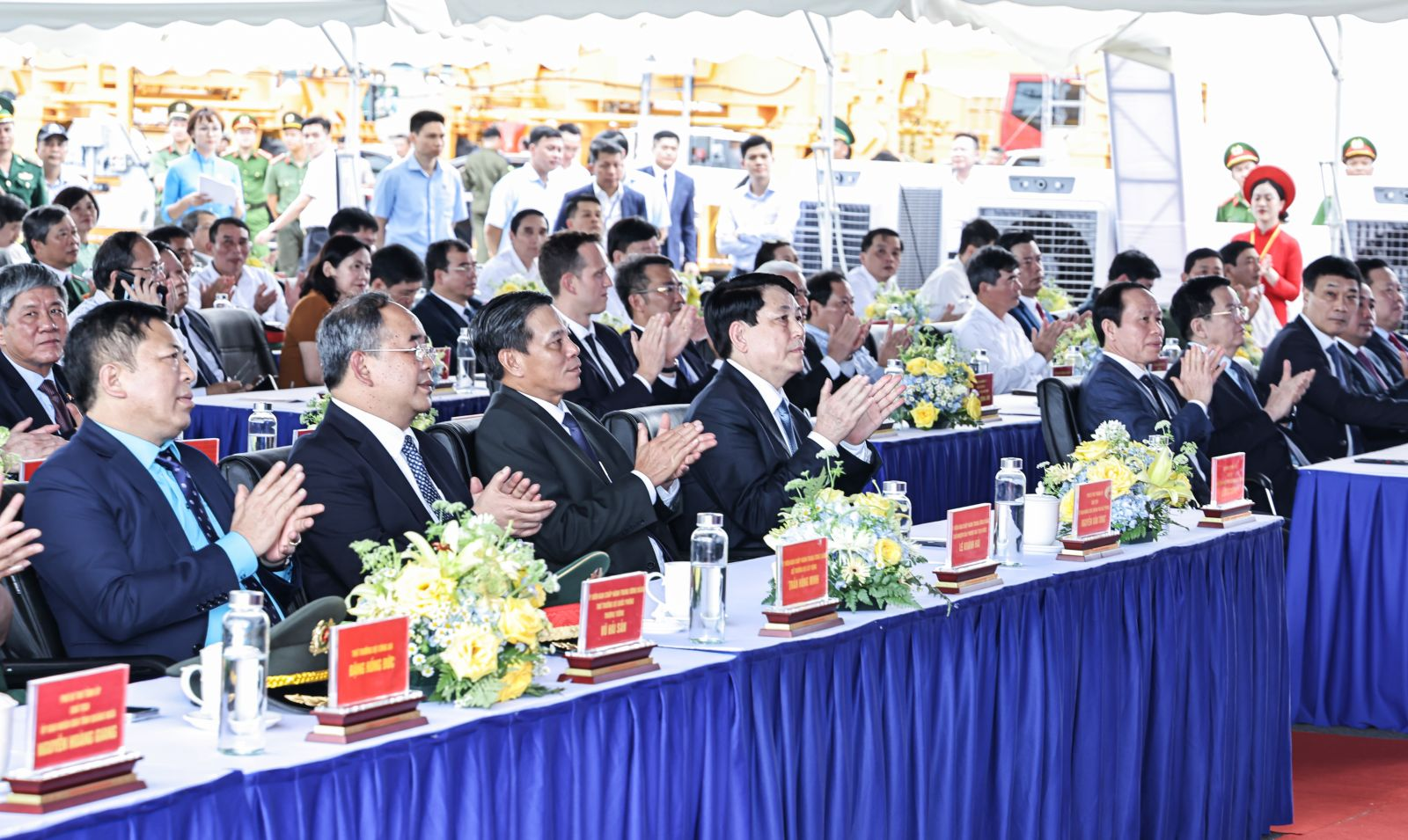
President Luong Cuong with delegates attending the inauguration ceremony of TIL Hai Phong International Container Terminal - HTIT (Berth No. 3, No. 4 - Lach Huyen Port Area).
Deeply grasping the spirit of Resolution 57, alongside the goals outlined in Resolution 45 and Conclusion 96 of the Politburo, Hai Phong has clearly defined its development orientation: high-tech industry, digital technology, and digital transformation as the central foundation. On this basis, the city has intensified efforts to attract strategic investment into industrial zones (IZs) and economic zones (EZs), shifting from breadth to depth, and from scale growth to enhancing quality and technological content in investment projects.
A clear testament to this shift is Hai Phong’s increasingly dynamic and diverse industrial ecosystem, featuring two major EZs—Dinh Vu–Cat Hai and the emerging Southern Coastal EZ—as well as 18 existing IZs spanning over 7,000 hectares. By the end of 2024, the city had attracted more than 840 investment projects with nearly USD 48 billion in capital. The average investment intensity reached USD 11 million per hectare—more than double the national average—confirming Hai Phong’s strong appeal to high-tech investors.
Notably, these inflows are increasingly directed toward large-scale, technology-leading, environmentally friendly projects with the potential to deeply integrate into global value chains. Leading world corporations like LG, Bridgestone, Regina Miracle, and Pegatron have chosen Hai Phong not just for its geographical location and infrastructure, but for its transparent investment environment, favorable incentive policies, and clear development vision. The presence of these “tech nuclei” has helped enhance R&D capacity, technology transfer, and the build-up of a high-skilled workforce—all key factors for the digital economy of the future.
Building on current successes, Hai Phong is now shaping a comprehensive ecosystem to ensure STI and DT genuinely drive development. The city is working in parallel across many fronts: completing institutional policies, developing modern digital and physical infrastructure, innovating investment promotion, improving human capital quality, advancing a circular economy, and constructing smart, eco-industrial parks and zones. The Prime Minister’s approval to establish a 20,000-hectare Southern Coastal EZ not only expands development space but also delivers a strategic jolt, affirming Hai Phong’s pioneering position on the national industrial map.
In particular, initial achievements such as raising the share of high-tech industry from 43% in 2018 to 60.6% in 2023—and maintaining industrial production growth at over 14% per year during 2019–2024—demonstrate the clear effectiveness of a development strategy based on STI and DT. These form the foundation for Hai Phong’s ambitious targets by 2030: elevating the share of processing–manufacturing industry in GRDP to 55%, raising high-tech industry’s proportion in total processing–manufacturing output to over 70%, and achieving an annual technology innovation rate of 20–22%.
Centering STI and DT in development not only showcases the city leadership’s strategic vision but also proves the agility, decisiveness, and receptiveness of Hai Phong’s entire political system, business community, and people. With such a strong foundation, the Port City confidently strides toward becoming a modern industrial hub—the driving force for the Northern region and the nation—contributing significantly to propelling Vietnam into a new era of innovation, creativity, and sustainable development.